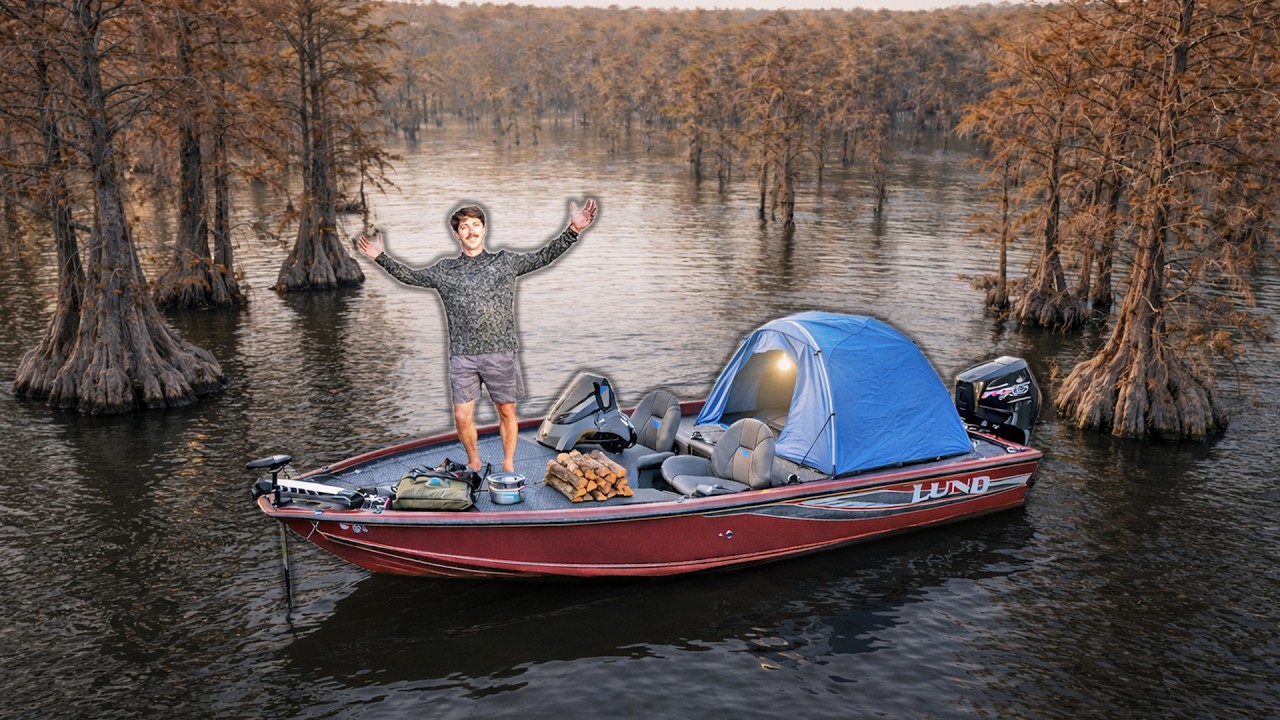
The cypress swamps of east Texas are one of the more unusual bass fisheries in the United States, and Jon B's latest video is a full immersion — a 24-hour boat-camp mission into Caddo Lake, the only natural lake in Texas, where tannic black water and ancient trees set the rules for how you fish.
"Well, this is it," Jon B said as he launched. "Our last look of civilisation before we venture deep within the cypress swamp of Caddo Lake right here. It's about as open water as you'll probably see from here on out."
The trip pushed back on modern deep-water bass fishing in two ways. First, the water itself. Caddo's tannic stain is a feature, not a problem.
"The clean water's good, but I think sometimes that clean water makes them a little spooky. But this tannic water is really nice because it has cleanish features without all the mud," Jon B said.
Second, the depth. The bass were in inches.
"Right now, we are currently fishing maybe, I don't know, 10 inches of water. It is so shallow. My trolling motor can just barely keep up and stay in this water level. But the bass don't seem to mind."
The baits were classic shallow-cover choices — a weedless frog, a Googan lunker log wacky worm, and a prototype weedless rat that Jon B singled out as part of an unreleased build for his Googan Squad line.
The forage-base framing was a useful reminder for anglers outside the US south.
"Because there's so much trees, these bass have access to terrestrial life. In other words, frogs, turtles, snakes, birds, and even the occasional mouse."
The timing of the trip placed him in the middle of the spawn window. Jon B walked viewers through how to read a bass for spawn status.
"A nice indicator to tell whether or not a fish has spawned is looking at its body morphology. If it's a skinnier fish, if it looks a little beat up, worse wear and tear, then generally speaking, it's a fish that has survived the spring spawn and is now on the chew."
The video's one genuine miss was the bowfin — a primitive Texas native that Jon B had been hunting for the full 24 hours and never quite put in the boat.
"They're nicknamed the grindle, which I think is a little more ominous and cool. They are a fish that's been around for millions of years. They're completely native to Texas. They've got big teeth, hard heads, and the way they swim is very unique."
For Australian anglers, the lesson is the mission length. A boat-camp sleepover on the water, with the rod back in hand at first light, is the same logic that turns Monduran or Awoonga barra trips from weekend drives into real sessions.
"We woke up this morning, and I think we caught our first fish by, you know, 8:30 a.m., like moments after we woke up and made breakfast," Jon B said.
Swap the bass for a barra and the calculation holds.