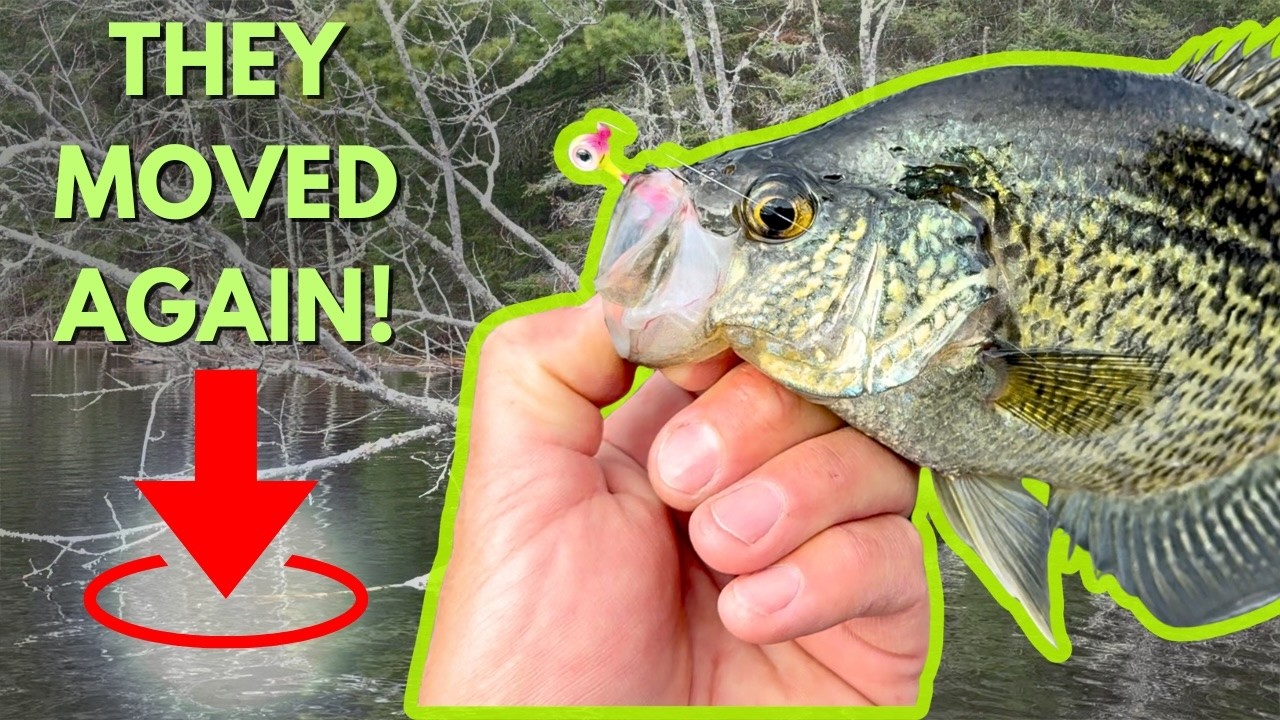
Spring is prime time for crappie, and an angler willing to chase the warmest water in the system can fill a livewell while everyone else is still scratching their heads. In a new tutorial, a Wisconsin crappie fisher splits the season into three stages — pre-spawn, spawn and post-spawn — and explains how to keep catching fish through each one.
Pre-spawn, he says, is the simplest, and it comes down to temperature. "Warm water is everything when it comes to pre-spawn," he said, nosing into a tannin-stained creek arm that warms faster than clear water. It was holding fish at 50 to 51 degrees the morning he filmed, despite a freezing night, with crappie stacked along a creek channel where stumps in four or five feet fell away into nine or ten.
That stacking is what makes the period so productive, even on poor lakes. "That's the beauty of pre-spawn crappies — if you can find the warm water, all the fish in that lake are going to be just jammed into that warm water," he said, noting the fishery was actually low-density yet loaded with fish in that one warm pocket.
For cold, lethargic crappie he rates a feather or marabou jig under a slip float above soft plastics. "These feather jigs just cannot be beat for these pre-spawn crappies," he said, explaining that the soft hackle breathes and pulses with the faintest ripple, looking alive while barely moving — something plastics can't match without far more work. He adds a touch of scent and sets the hook with a gentle lift when the float dips. A live minnow under a bobber is his other staple, and where two rods are legal, as in Wisconsin, he runs both.
The jump from numbers to quality, he stresses, is all about cover. After boating small fish in open channel, he eased onto a half-submerged tree and immediately upgraded. "Find the warmest water like we did right away, find some sort of cover in that area. You need to find either wood or weeds that are going to hold fish," he said — a tactic that works fine without electronics by simply anchoring on visible structure.
As the spawn nears, he expects fish to fan out toward the main lake and bury into vertical cover at the right depth. The depth is what matters, not the cover type. "Just because somebody tells you, 'Oh yeah, crappie spawn in bulrushes' — well, if they're too shallow, they're not going to. They're going to spawn in some kind of other vertical cover." He shortens the leader to hang bait a foot off the bottom over beds, sticking with floats because spawners won't move far for a lure.
Post-spawn, the fish slide to the nearest drop-offs and weed lines and hold on cover rather than scattering — the cue, he says, to switch to moving baits like plastics and small spinners to relocate them.
It adds up to a clean spring blueprint: find the warmest water, use cover to sort out the better fish, then follow them to the edges as the spawn fades.