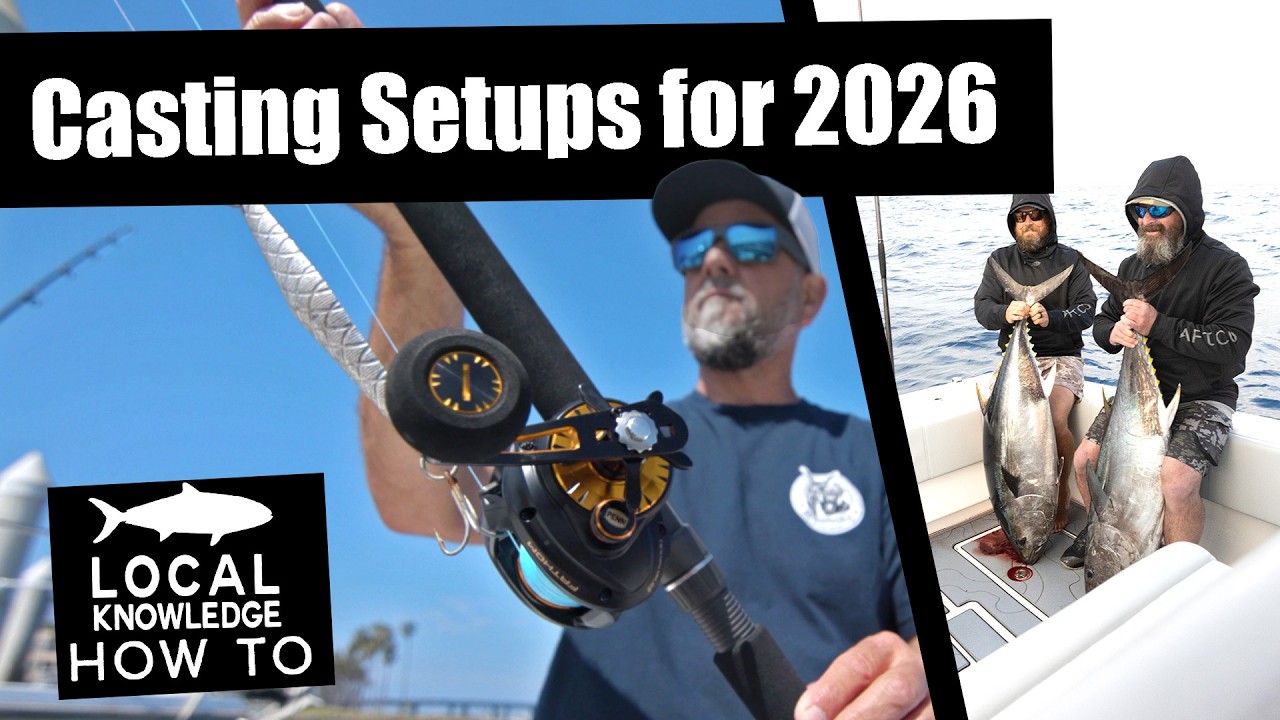
For the crews running clients out of Southern California for casting bluefin, the rig conversation rarely strays past three rods on the deck. Ali from Local Knowledge has been fishing prototypes of Penn's new Fathom 500 lever drag for almost a year, and his 2026 walkthrough is essentially a hard endorsement of the new reel — paired with two specialist setups for everything bigger than a hundred pounds.
The shop's everyday workhorse is a 9-foot Penn jig stick. Ali had a hand in the design and prefers a fast-action graphite blank over the old slow-arcing 90J style of jig rod, mostly for casting control around the tower.
"This style of rod allows you to shape a lot more cast so you can throw a low liner into the wind. You can lay it up really high in the wind. You can cast over people. Cast better in tight quarters in my opinion," he said.
The reel on top of that rod for 2026 is the Fathom 500, which Ali says has been hammered through a year of testing with no real failures. "We literally did everything in our power to break these and we were unsuccessful," he said. "We've cast it and caught tuna up to about 180 pounds with this reel."
He sets a clear ceiling on what the jig stick is for. "This is going to be my setup that I'll use for tuna up to about 80 or 100 pounds. A 100-pound tuna on a 9-foot jig rod is going to give you all you want and probably more."
The middle rig is built to handle anglers who want to keep using surface irons, stick baits and poppers without giving up the option of hooking the wrong fish. Ali loads sixty-pound braid on the spool — lighter than most charter operators in the region run — and explains the trade-off bluntly.
"I know it sounds a little light, but that lets me have 300 yards of line on here in case I hook the wrong fish, and realistically with sixty, you can pull almost as hard as you want and you're not going to break anything," he said. He ties his sixty straight to a forty-pound Seaguar Gold leader, a knot he says has become his default. "Gold has quickly become my favorite Seaguar Leader. It's just easy to tie, very thin, very soft."
The third rod was born out of necessity. Three or four years ago, Ali says, the bluefin off Southern California stopped eating the flyer almost entirely for two months at a time, leaving anglers to chase foamers with whatever heavy gear they could rig up.
"After trying a few different things, I went through my Penn rod selection and I found this particular rod. It is an 8-foot rod. I believe it was designed for wahoo bombs. It's rated at 40 to 80 pounds," he said. The reel is an old-school black Fathom 25 lever drag two-speed.
The two-speed solves a problem unique to foamer fishing. "When you cast and don't get bit, or if you cast and miss, you've got really high gearing to get that lure back to the boat as fast as possible," he said. "A lot of times these foamers only stay up for a few seconds. So if you can get a second or third cast in because you've got the speed to retrieve your jig, that can make a huge difference in your day."
Sixty-pound braid stays on the heavy rig too, this time matched to an 80-pound leader and stepped up to 100 or 130 if the fish are biting line off. "I'll trade the line capacity for the ability to just pull stupid," Ali said. "Sixty-pound braid is going to break probably at 70, 75 pounds. That'll let you pull up to like 20, 25 pounds of drag, which is a ton on a casting rod and not have to worry about anything."
His final note is about discipline rather than tackle. Foamers, he says, do not reward long casts in the wrong direction. "If you can't reach the foam, don't cast. If you're going to off the wrong side of the boat, don't cast. Be patient. That's really been the key."