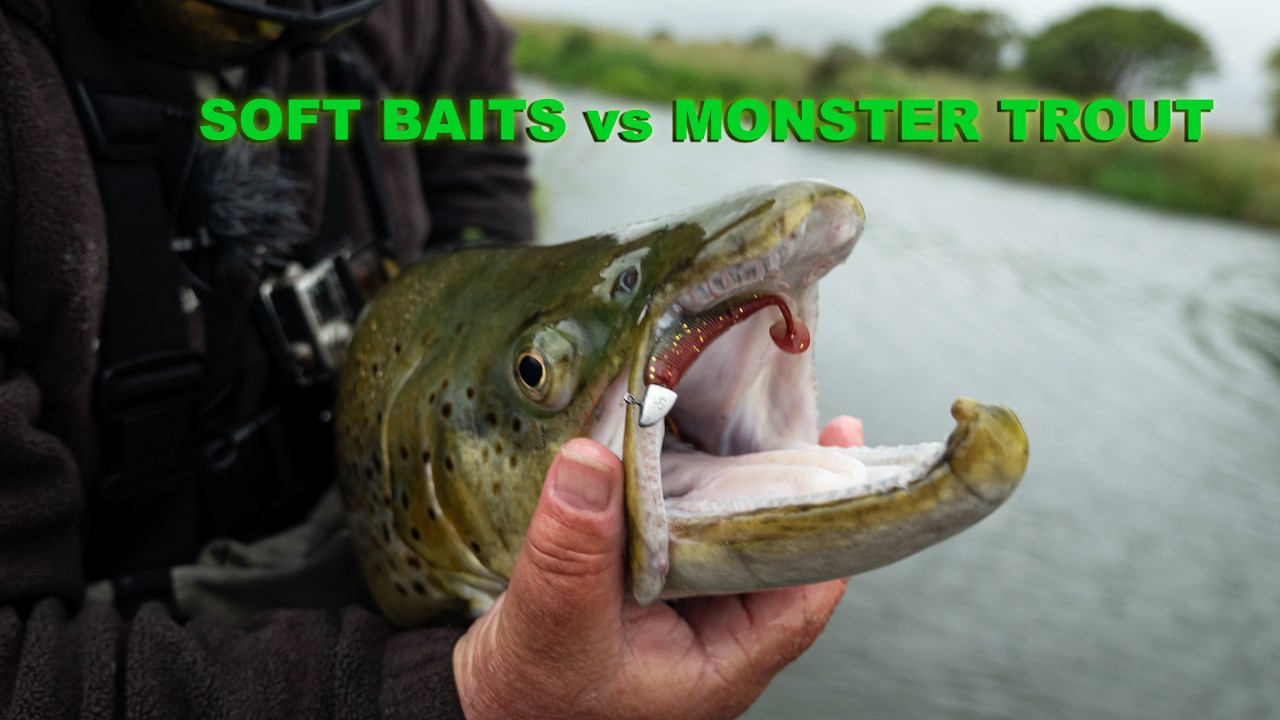
A fly rod is the standard tool for chasing wild trout in New Zealand's South Island. On a recent multi-day trip through central Canterbury, Adam from the Fishy Business YouTube channel left his at home — and let soft plastics do the work instead.
"I'm not fly fishing today," he said as the trip began. "I'm actually joining up with a few mates and we're going to be soft baiting for trout in a few different spots all around the South Island."
His gear is pared back: a long, soft-tipped rod built to flick a tiny jig head a long way and still soak up the lunges of a heavy fish, good braid and roughly two metres of fluorocarbon. The real detail is in jig-head selection, and here the crew's veteran, Malcolm, didn't hedge.
"Generally I would work anywhere from a 16th of an ounce up to maybe a quarter of an ounce in very heavy water," Malcolm explained. "But a 16th of an ounce and a 12th of an ounce would be the most common I'd use, both in lakes and in river situations."
Much of the technique is lifted straight from fly fishing. Casts go upstream, ahead of the fish, with the lure drifting back down naturally. "We generally fish them upstream so that you're behind the fish — you don't scare them," Adam said. Seeing the trout before casting is critical: "Good quality polarised fishing glasses are essential for this kind of fishing. You'd never see a well-camouflaged trout sitting on the bottom without removing the glare."
The fish came fast. Malcolm boated four in the first couple of kilometres, including a tidy five-and-a-half-pounder, before the group shifted to Lake Sumner. Working Bait Junkie 2.5 minnows in natural colours over the lake's edge with a slow, erratic retrieve, they reckoned on five fish in the opening 20 minutes.
"The soft baits are just creaming these fish," Adam said. "It's such a cool way to fish. Not hard — you've just got to get the weight of the jig right and the right colour soft bait, and you're away. Very different to fly fishing. Probably a little bit easier, to be honest."
The trip peaked on its roughest day. Malcolm guided Adam to a small creek he had fished as a teenager, where Adam pinned a thick brown that dived for the weed before coming to the bank — an "absolute ripper" he estimated at 10 pounds. He passed it to Malcolm for the release. "Seeing as it's your spot, I'll let you release this beauty for me," he said.
Every fish went back, as is customary in the back country. Anyone tempted to copy the trip should remember that trout fishing in New Zealand requires a licence and that rules differ by region, so it pays to check the Fish and Game website first.