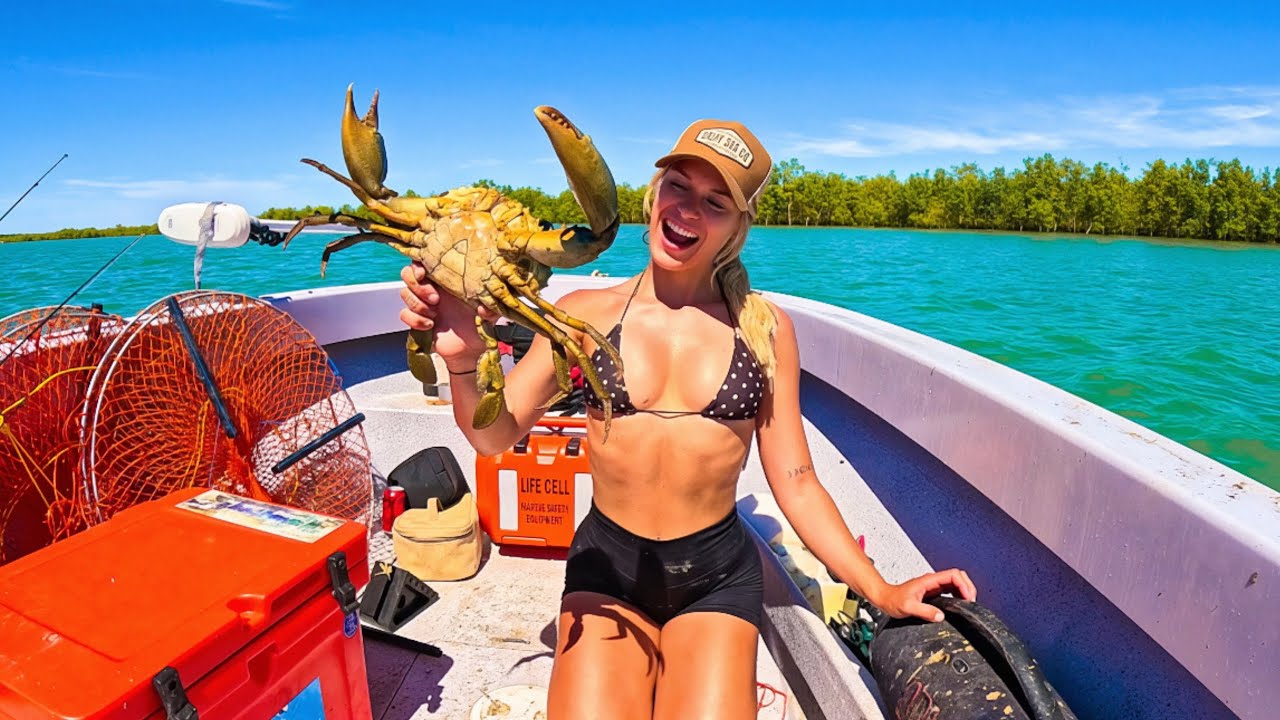
Molly Dixon's latest Gulf country episode is the kind of fishing video the Far North Queensland coastline produces on its better days — light tackle, light expectations and a feed that justifies the drive.
Dixon, freshly across from Tasmania via Cairns and a long drive over to the Gulf, set out from a small camp with travel partner Jaz and a working theory. The barra had been thin through the week, the locals were calling the bite quiet, and the morning called for a pivot. Mud crabs.
"This is my favorite food, hands down. Honestly, nothing beats it," Dixon opened with — a line she would close the episode on as well.
The plan was unfussy. Four crab pots, two old fish frames split between them, all four floats clearly marked with name and number per the regulations, all four dropped in the mouth of a small creek system on a falling tide. Pots in by mid-morning, fish for the afternoon, check the pots before dark, soak them overnight and revisit at sunrise.
The first round of the soak ran flat. The afternoon flick produced nothing through a stretch where the bait was clearly on — diamond mullet jumping out of the water around the boat, fish marks on the sounder that refused to commit, and a constant stream of jellyfish in the pots when the first check came around at last light.
"Maybe there's just too much for them to choose from," Dixon said of the bait fields, before calling the line dry and pulling back to the boat ramp with the pots left in for the morning.
Sunrise reset the day. Pot one came up with a catfish and a load of jelly. Pot two surfaced a single keeper buck. Pot three pushed it to two more. Pot four — Jaz's go on the rope — came up with another two crabs and a small bycatch fish riding inside the cage.
"This is why crabbing is so fun. It's such a guessing game," Dixon said as the last pot came over the gunwale.
Three pots, multiple keepers, no need to step it up to a Plan B mangrove walk. The crabs went into a salt-water boil on the beach a couple of hours later, cooked in nothing more elaborate than seawater and a beach burner moved to the floor to escape the wind. Twelve minutes in the pot, then straight onto a board.
"How delicious does that look?" Dixon asked the camera, before answering it. "Mate. So delicious. This is my favorite food, hands down. Honestly, nothing beats it."
The smaller story across the run is what makes mud crabbing work in Gulf country. Bait choice — a sizeable fish frame and head, tied tight in the centre of the pot, gives the crabs something they have to commit to. Float compliance — names and numbers on every float — is non-negotiable. And a Plan B — a mangrove walk if the pots fall short — is built into the day before the first pot hits the water.
Dixon signed off with the line that has become a quiet through-theme of her Northern series: it is going to be hard to go back to Tasmania after this. On a flat morning in Gulf country with three muddies in the pot and a salt-water boil-up on the beach, that line writes itself.