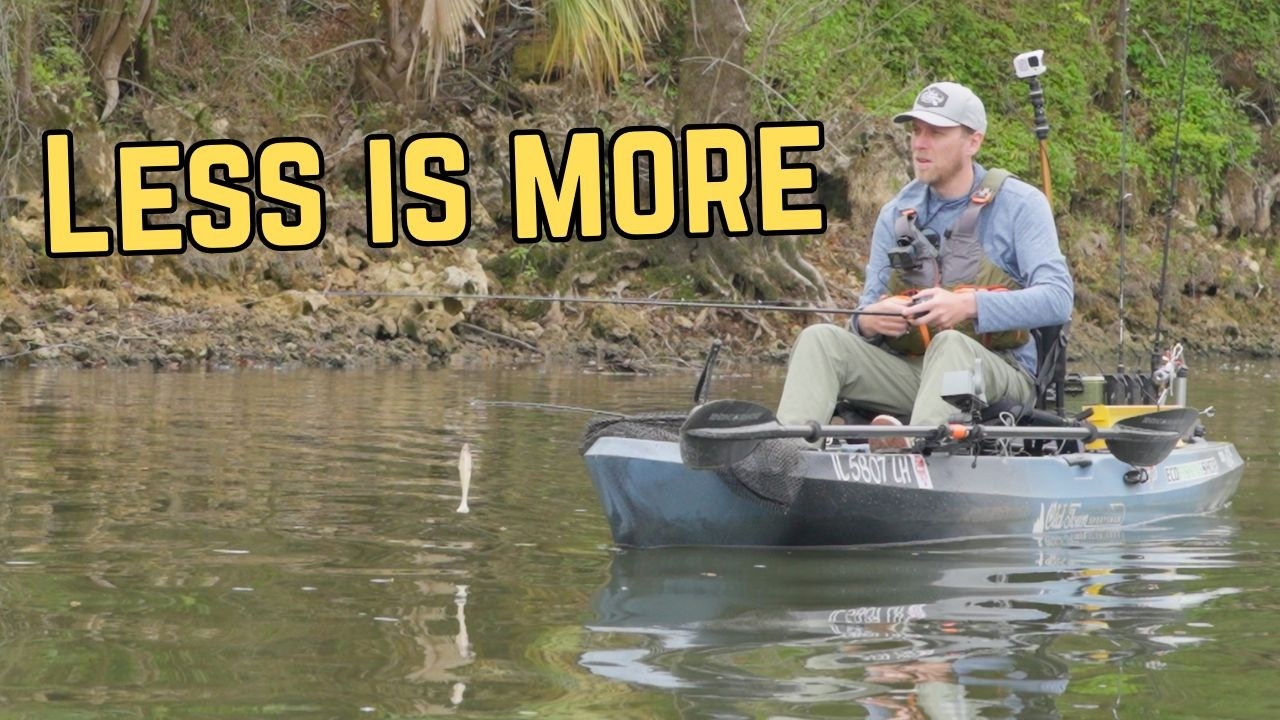
In a corner of the sport where bigger, heavier and more expensive is often treated as better, one kayak angler is making the opposite case — and says it has made him a sharper fisherman. After six months running a sub-$1,000 build, the angler behind the IL Yakkin channel argues that the boat under you matters far less than most paddlers think.
"We overcomplicate kayak fishing," he says. "It's probably not the gear, and it's probably not the kayak, holding you back. It's your mentality."
The build at the centre of his case is an Old Town Sportsman 120 Paddle — the bare-bones version of the popular hull, bought for $799 on a Black Friday sale. To it he added a stern-mounted motor with foot steering, a slight seat riser and little else. "What you see is what you get," he says of the stripped-back platform. "I wanted something that was a blank canvas."
The motor conversion, which he says he has since helped more than ten subscribers replicate — including Creek Fishing Adventures' John Dalton — uses through-hull foot-steering eyelets for a clean, tight turning radius. But he is quick to stress the build is deliberately minimal. There is plenty of track space for a graph or an anchor system, he notes, "but it's not for me."
His core argument is that chasing the "perfect" kayak is a trap. "The perfect kayak just doesn't exist," he says. "You're not going to want to take a PA 14 down a creek, and you're probably not going to want to take a sit-inside kayak to go live-scoping out in the Great Lakes for smallmouth. Two different tools for two different things." The mistake, he believes, is assuming an upgrade will fix a fishing problem that was never about the boat: "Upgrading my kayak multiple times over five or six years wasn't helping me catch more fish."
So did the cheap rig actually put more fish in the boat? His answer is a qualified yes — built on a few practical advantages. Chief among them is stability. The Old Town's primary stability let him stand and fish far more often through winter, which he credits for a better season throwing his favourite jerkbait. "The best way to fish a jerkbait from a kayak is in the standing position," he says. "A lot of those little things really added up."
A simpler boat also meant faster launches and a more disciplined approach to tackle. With no horizontal rod tubes practical alongside the foot steering, he is limited to two or three rods up front — a constraint he came to value. "Because I'm limited on how many rods I feel comfortable bringing, I plan my trips out a lot better," he says. "It forced me to think smarter about what to bring."
He is careful not to dismiss elaborate setups entirely, praising brands like NuCanoe for their modular, customisable designs and acknowledging that big-water anglers genuinely benefit from larger, motor-and-graph-laden platforms. The point, he insists, is matching the boat to the fishing. "Buy a kayak that fits your needs. Buy a kayak that's going to help your goals."
His closing message cuts against an entire genre of gear-obsessed content. "The kayak is the last thing you should be worrying about when you're fishing," he says. "The kayak is a tool. You should be focusing on catching the most fish." By simplifying, he reckons, he finally did exactly that.