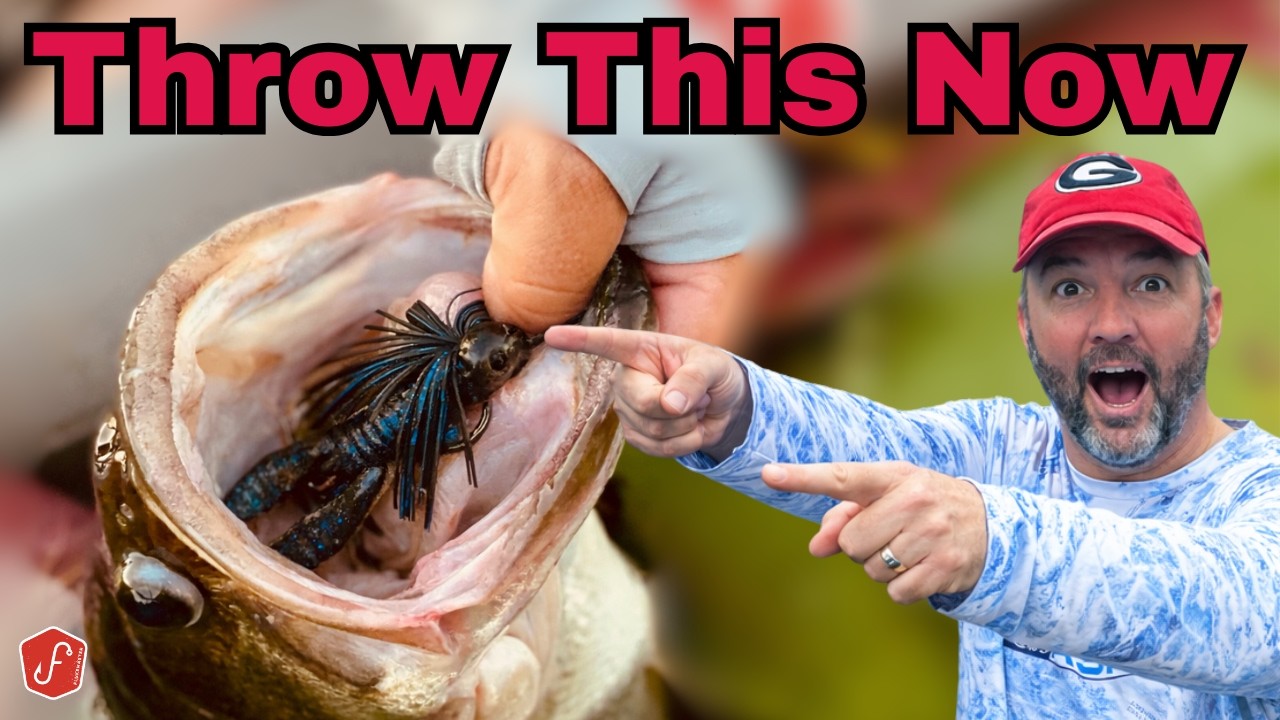
Veteran US bass educator Gene "Flukemaster" Jensen is pitching one simple switch for anglers chasing their biggest spring largemouth: put the jerkbait down, pick up a flipping jig, and commit to fishing it painfully slowly in the thickest cover on the lake.
In a new tutorial titled "Why a Jig Catches Bigger Bass Than Anything in Spring," Flukemaster argues that spring's moving-target behaviour — pre-spawn, mid-spawn and post-spawn fish rotating through the same shallows at the same time — pushes most anglers into over-using reaction baits.
"Spring fishing is just weird because the fish are always moving," he tells viewers. "They're trying to go up to spawn, they're leaving from spawn. You got pre-spawn, post-spawn, middle-spawn fish and it leaves a lot of us guessing."
"We rotate through all kinds of moving baits and all kinds of reaction baits," he adds, "and we forget that sometimes you just got to slow down. The fish are there, they want to bite and especially the big ones, they're just not willing to move far to get it."
The bigger-bass-on-jigs argument comes down to three things, in Flukemaster's framework: what the jig imitates, how much time it spends in the strike zone, and where you can put it.
"A jig imitates a crawfish or a bluegill and those are both primary food sources for a bass that's getting ready to spawn and or trying to feed up after the spawn," he explains. "The bigger bass will key in on the larger crawfish and those 3 and 4-inch bluegill."
The second benefit is control. A flipping jig fished into cover spends vastly more time in strike-zone water than a crankbait or a jerkbait sweeping past shoreline targets.
"Because you're fishing it considerably slower than like a crankbait or a jerkbait or anything like that, you're able to keep it in the strike zone longer," he says. "A lot of times those fish aren't willing to move very far or chase your bait."
"Don't be scared. That's a big mistake that we make," he says. "Do not be scared to throw this thing into thick cover."
One detail he's adamant about: this is not the season for a football jig, his own self-admitted favourite. Spring bass tie to visible shallow cover — laydowns, stumps — and a football head is built to crawl offshore structure, not work in and out of heavy timber.

"This is not the time for a football jig, and I'm a football jig freak," Flukemaster admits. "But I love to fish offshore structure. This time of the year, they get tied into that shallow cover."
The single change he says transformed his spring catch rate is retrieve speed. He describes flipping the jig alongside a laydown, counting the sink, then shaking the rod tip without moving the bait.
"Let it sink to the bottom, count to two or three, four seconds and then just shake it without moving it," he says. "A lot of times these fish are a little bit up off the bottom. They're suspended, especially in a little bit deeper water. And that jig comes past them and goes down. They're not willing to chase."
He adds another under-used presentation for laydowns: pitch across the trunk, hang the jig on a branch, and shake it on the wood.
"Before you pop it over that limb, just hang it on that limb and shake it a little bit," Flukemaster says. "A lot of times you'll get bit right off of that limb."
Flukemaster's closing mantra for anglers nervous about wrapping a jig in a laydown is one he repeats before every committed pitch.
"I'll hook him first and worry about the rest later," he says. "Get it into that thick cover."
For US spring anglers — and for Australian bass fishers with native bass coming off their own winter transition — the message is blunt: the biggest fish in the shallows in April and May are often the ones not willing to move a foot. A jig, worked properly, is the only bait that asks them to move exactly that far.