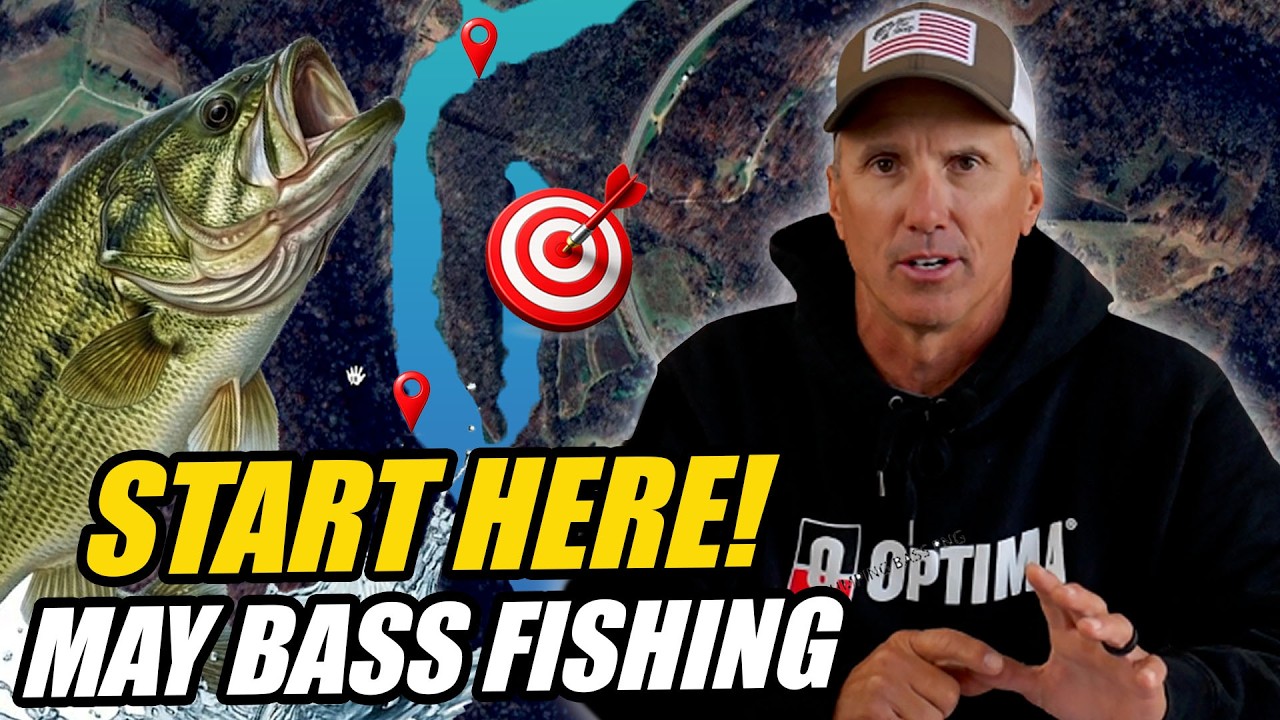
Major League Fishing pro Edwin Evers has launched the May 2026 instalment of his "Where to Start" series, and rather than picking apart a single tournament fishery he has dedicated this episode to one of the trickiest May puzzles in American bass fishing — the river spawn. The Oklahoma pro, sponsored by Optima Batteries, ran his subscriber-suggested list through Google Earth and broke down three rivers he has never fished but would love to: the Columbia in Washington, the Ohio between Pomeroy Point and Ravenswood, and the Alligator River in coastal North Carolina.
"I'll give you a million bucks if you can go catch a bass within an hour. The one spot that I'm going to run to on this body of water that I have seen is this deal right here," Evers said, gesturing to a backwater on the Columbia River with an old road running down the centre of a long canal. "I have got something — an old road that runs down the center of this canal. They are going to spawn on that thing like every year. Like to me, if I had to go catch a bass, that's the spot that I'm going to go catch one."
The thesis underpinning the entire video, Evers explained, is to look for spawning bass that have moved out of the direct main-channel current. "Out of direct current, you've got to get in if it's going to be smallmouth, a secondary minimal current. If it's largemouth guys, the best spots out of the current — dead-end sloughs, dead-end canals, dead-end stuff where there's not a lot of current," he said. He acknowledged the trade-off — backwaters often lack the harder bottom that bedding bass demand — but argued the fish would prioritise stable water over substrate.
For the Columbia, Evers identified marinas as a no-brainer first stop because they sit hard against the main river channel where smallmouth spend the rest of the year. He liked steep rip-rap, hard banks and the inside bend on a section he zoomed in on, where a sneaky deep pocket tucked behind a hard-to-access entrance "will load with any fish that's within a half mile of it." The big backwater with the centre-line road, however, was his single highest-confidence pick.
The Ohio River drew a more sympathetic verdict. "I feel like this stretch of the Ohio River is going to have a lot of smallmouth in it. It's probably your predominant species," Evers said, before adding a frank assessment of the floodplain. "You men and women that fish the Ohio River, I feel sorry for you. Like you guys are like the cream of the crop, the best of the best because you're having to fish for a very small population of bass. There's just not a lot of spawning habitat in there." He highlighted a tight backwater pond that drains only ten acres — "a rain, it's not going to muddy it up" — as the kind of micro-area that holds shallow spawners on a stable river.
The Alligator River drew Evers's biggest enthusiasm. He noted the Albemarle Sound system holds remarkably little tide despite its proximity to the Atlantic, and that the wind drives more water movement than the tide cycle does. With an 18-mile-long body of water to break down, he steered viewers into a vast wind-protected backwater on the inside of the system, where dozens of small drainages fall off harder bottom edges into the main flat. "I am going to fish around these points... because that's going to be a harder bottom. Current, wind-driven current going in and out," he said.
Evers conceded the Alligator River may already be wrapping its spawn by May because of the southerly latitude, but argued that if the bass have already moved off, the same wind-driven points and drainage mouths will hold the post-spawn fish staging back to the main lake. The Oklahoma pro closed the episode by reminding viewers that river bass can spawn at extremes — "either really early or really late" — and that anglers who can find stable, low-flow water will get their shots regardless of the calendar.