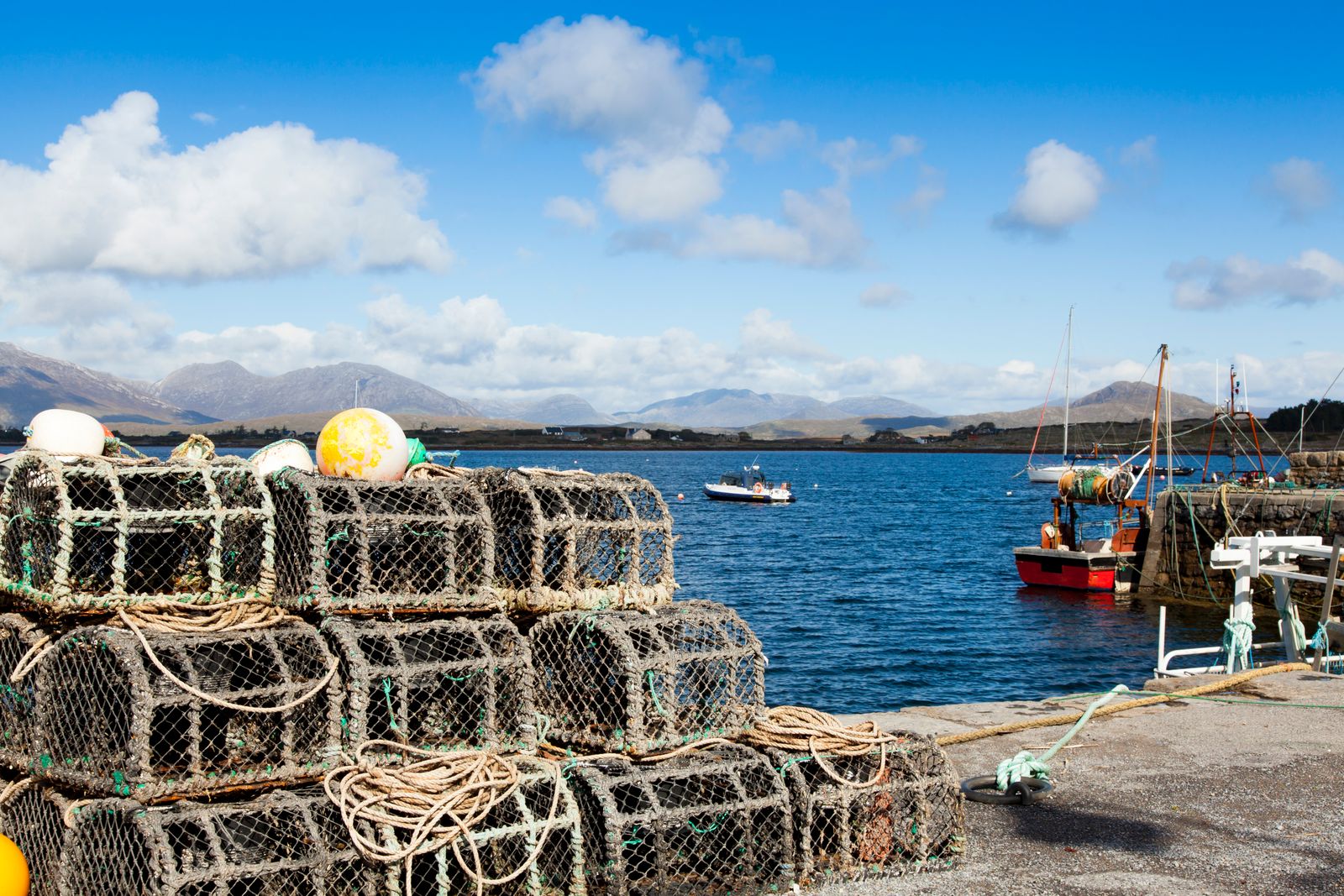
The crab leaving Leenan Pier in Inishowen this month is flown live to Beijing inside three days. The lobster goes to France. What stays in County Donegal, the men landing it say, is getting harder to live on.
Robert Kearney showed RTE a haul he called unremarkable for the season. "This is a typical catch for August; there's a lot of soft-shell crab on the ground [sea-bed]. We don't have a big quantity of crab, but the quality is very high," he said. "This is destined for China. A van will take it away tomorrow and it will be flown live into Beijing within two to three days."
The margin is the story. "This may look like a good catch; but it's leaving it tight on the line for running costs. A boat of this size here today, for the diesel and the bait was 800 euro," he said. Four years ago, he added, bait and diesel were 200 euro apiece for a full day.
Prices at the buying end have gone the other way. "The price of the shellfish seems to be coming down. It's balanced out now at half the price that it was five years ago," Kearney said. "We've three men on deck and myself; four men to pay. We've bait. We've diesel. It's so tight." He put a word on it that has since travelled: "If it goes any further, I would nearly call it Armageddon for the inshore fleet."
Small-boat fishing here is family work, and that is what makes the squeeze bite. His brother Martin, who works lobster pots off a small boat, told RTE the household economics are direct. "Our whole family is based off fishing. If it gets any worse, I'd say it will just be a matter of trying to look for different jobs; that's how important it is - it's running all our houses." He also flagged an asymmetry familiar to anyone in a price-taking trade: "It seems to be just whenever the price of fuel goes up, everybody else is able to put their prices up, except the fishermen."
Martin Kearney still calls it "one of the best [jobs] in the world" - while conceding that the plan he started with is gone. "About five or six years ago, I bought my own small boat for fishing lobsters; I always thought I'd be able to build it up and someday get a bigger boat, but that's out the window at this stage, unless you put yourself into massive debt."
Denis Kearney has worked crab off this coast for 48 years. "I'm fishing since '78... I would say people are just struggling. They're making no fortune," he said. "You couldn't even go now to buy a new boat. Everything has gotten too dear; too expensive. It's all family run boats around here and it's very hard work."
Dublin's response has been fuel relief. The Fishing and Aquaculture Registered Vessel Fuel Support Scheme, administered by Bord Iascaigh Mhara under the EU Temporary Crisis Framework, covers March to July 2026. A Department of Agriculture, Food and the Marine spokesperson told RTE more than 8.5 million euro had gone out on 397 applications, with a final figure near 9.8 million euro expected.
Robert Kearney's verdict on the paperwork was less generous. "That fuel subsidy; there was so much red tape and paperwork... they put you through so many loopholes to get so little," he said. "It was like a week at school. They can simplify it."
For the National Inshore Fishermen's Association, fuel is a symptom. On The Fishing Daily podcast in March, chair Michael Desmond and vice-chair John Menarry argued that quota consolidation has hollowed out the small-boat sector: an extra 32 million euro of mackerel quota allocated to Ireland, they said, largely lands with a handful of large refrigerated seawater vessels, while more than 300 inshore members see none of it. Roughly 40 inshore boats can fish hook-and-line mackerel at 10 tonnes each against a 20,000-tonne national quota. In the North West herring fishery, 1,500 tonnes went uncaught while inshore boats were capped at 350.
Desmond said fishermen ring him daily to say they cannot afford to sail. Both men described coastal communities sliding toward "ghost towns", and questioned official profitability figures for Irish seafood, arguing imported product processed and sold as Irish disguises falling Irish landings. NIFA has also said the government task force it was directed to engage with effectively stalled, with meetings delayed and no formal explanation.
That process now rests with a Food Vision Seafood Sector Group under former IFA chief executive Michael Berkery, established in the spring by Minister Martin Heydon and Minister of State Timmy Dooley, reporting later in the autumn.
The people waiting on it are already at sea. Robert Kearney's 13-year-old was up at 5am for a soaking morning in a four-to-five westerly; his 18-year-old has been on the payroll since school. "We want to pass it onto the next generation," he said. "I would love to think in a few years, if they wanted to fish that there's something there."