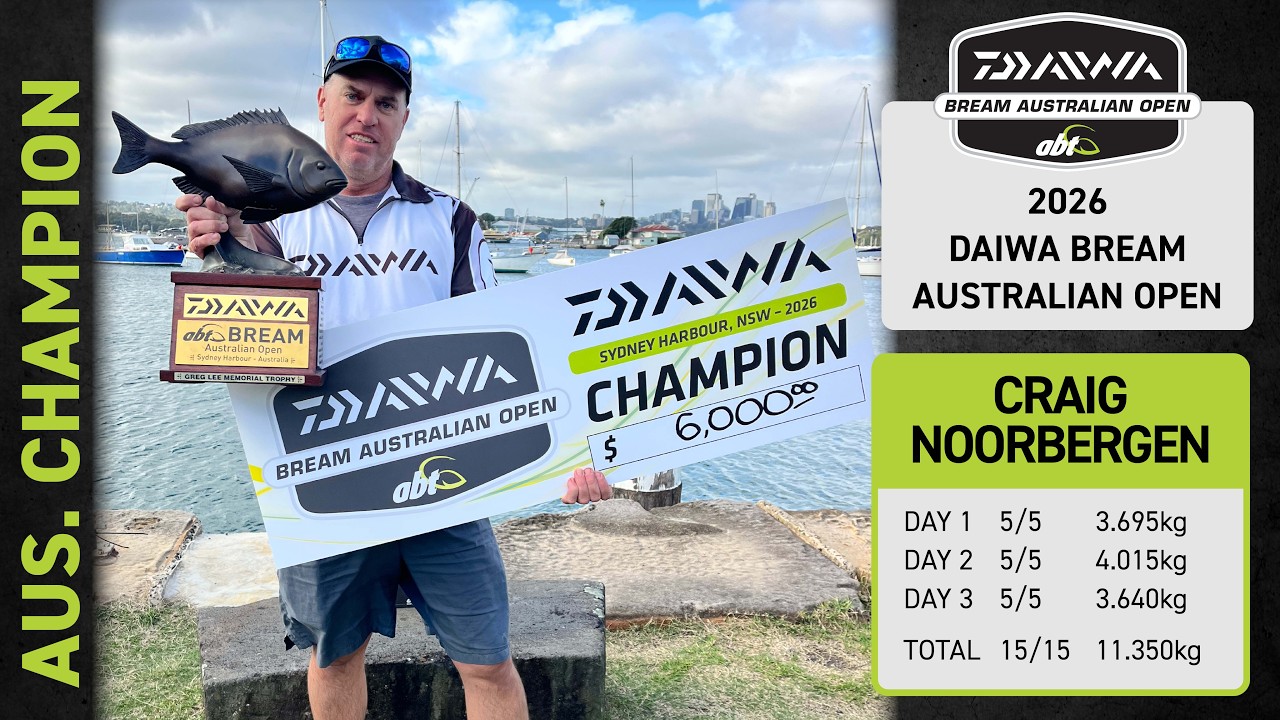
Sydney bream specialist Craig Noorbergen has done what almost no one does on debut — won the open Australian title on his first attempt — pocketing the Greg Lee Memorial Trophy, six thousand dollars and a year of pressure on a UV Cranka Crab fished into eddies behind Sydney Harbour pontoons.
The 2026 Daiwa BREAM Australian Open wrapped up over the weekend with ABT's Steve Morgan interviewing Noorbergen at the weigh-in. Most of the field had been spread across Sydney's better-known bream water for three days; the new champion went home each night.
"I come from Baulkham Hills. I've lived in Sydney all my life. So I'm a Sydney local. I fish Sydney Harbour quite a lot," Noorbergen said. "It makes it a little bit more comfortable entering a competition like this having a bit of experience and local knowledge and that sort of thing."
Noorbergen had a personal connection to the trophy he had just won. The award honours Greg Lee, who famously came from tenth place to win the open with over five kilos out of the Lane Cove River on the final day.
"Yeah, that's right. Yeah, yeah, absolutely," Noorbergen said when Morgan reminded him of Lee's history. The Lane Cove River turned out to be one of his own anchor spots for the weekend.
"This week I just pretty much ran between Lane Cove River and upper Parramatta River sort of thing," he said. "Fishing along rock walls and jetties, pontoons, that sort of thing. Anywhere there was a bit of flow."
Flow was the central variable. Noorbergen wasn't fishing the structure itself so much as the broken water immediately behind it.
"I'm looking for eddies generally in behind poles and pontoons and that sort of thing and trying to throw the crab into there," he said.
The weapon, when Morgan asked for it on camera, was a UV Cranka Crab on a Daiwa Revelry 3000 reel and a 782 LFS Daiwa rod — what Noorbergen called "a crab rod" — strung with 10 lb test and leaders running between 8 and 10 lb. Heavy by Sydney clear-water standards, but he was unapologetic.
"I know is pretty heavy, but I don't think the heavy leader really affects the crab bite so much because Sydney Harbour obviously is not crystal clear like Pittwater or Cowan Creek," Noorbergen said. "It's got a bit of colour to the water, so I don't find the leader puts them off. And I still got smoked twice even on 10 lb leader on fish that I couldn't stop."
His cast was upcurrent into the eddy itself, with the crab landed inside about six inches of the pole.
"What I'm trying to do is approach from coming into the current, so if I've got a pole or a pontoon in front of me, I come up to it and try and throw the crab into the little eddy behind," he said. "Sink it right down. Getting it within 6 in of the pole, I think it's quite important because the way I look at it is that fish are probably feeding on the pole or waiting for food to drift past, so getting it in tight to the pole is important."
The bite, almost without exception, came at the bottom of the drop.
"I reckon pretty much all the time just as it hits the bottom," Noorbergen said. "If not, I just give it a real little shake. All I'm trying to do is lift it, get the claws moving, and just get the crab just hopping a little bit on the bottom and get the claws moving."
Spot rotation was simple — roughly three passes per location per day, hitting the same structure at different stages of the tide.
"You go there first time, don't get a hit, second time you don't get a hit, you go there third time you might get one," he said. "It's hitting basically the same spots at different stages of the tide and just hoping that the fish have moved in on those areas, and usually it works."
Noorbergen, a long-time member of Western City Bream Bass club, finished the interview with the advice Morgan asks every champion to give to the anglers watching from the sidelines: "Have a crack."