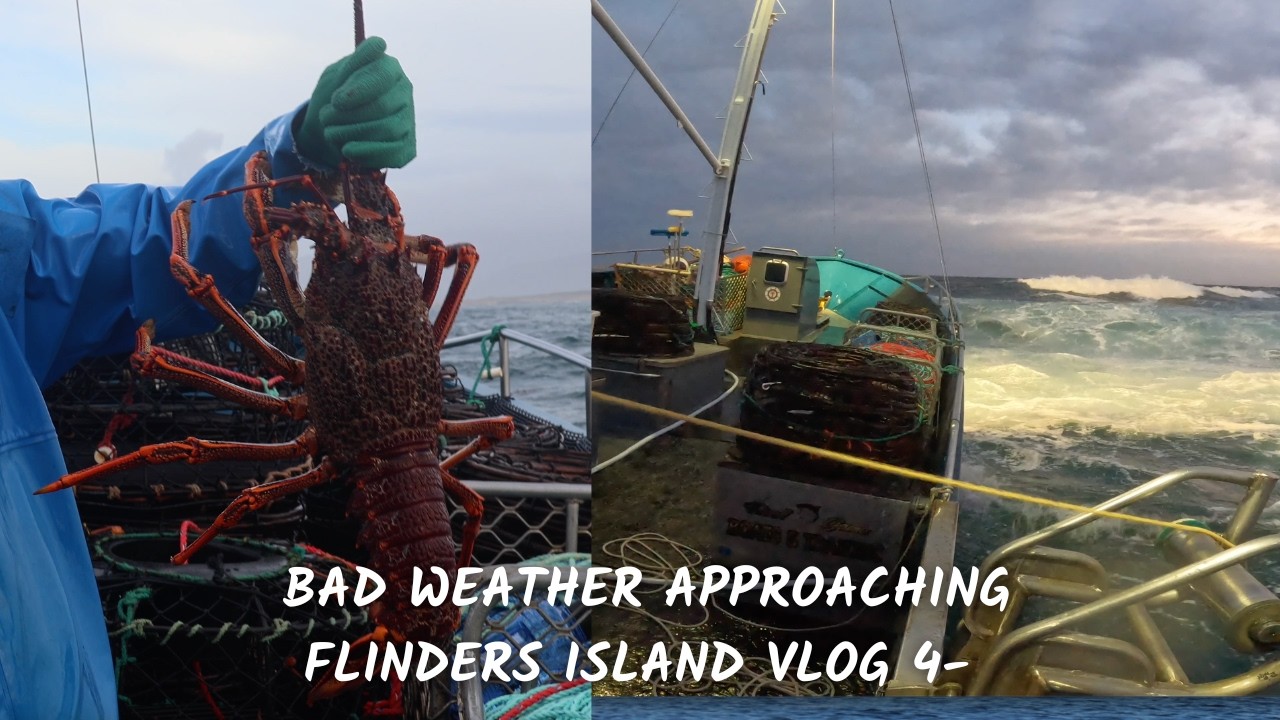
The fourth instalment in the Aussie Lobster Hunters' Flinders Island vlog series, published on 17 May 2026, captures the moment a quiet commercial trip turned into a weather-management problem. With a 30-plus-knot northerly forecast and pots sitting on shallow, breaking reef, the skipper had only the early morning to get the gear back on board before the swell shut him out.
"Today is going to be a not-so-good day weather-wise. We've got 30-plus knots coming down from the north," he told viewers as the boat pulled the anchor at 6:30 a.m. "Our gear's hidden in behind some rocks and we're hoping to be able to get it back today so that we can shoot it back in and have another day on anchor."
The forecast read off the plotter was a three-day write-off: 25 knots gusting to 40 by early afternoon, a westerly change overnight, then a full day of 30 knots from the south-west. "Then it comes up south-easterly and then we finally get a good day Thursday, Friday, and then it comes back down again," he said. "So, anyway, is what it is."
Southern Rock Lobster do not feed in dirty, rolling water, and the morning's catch confirmed it. "The way the Southern Rock Lobster work is, normally in shallow, if the swell picks up and it's rough, you don't tend to catch anything," the skipper explained as the boat nosed onto a reef edge with white water breaking off the bow. "We don't need to be getting cleaned up by any breaking waves as we're trying to pull shallow gear."
The bigger ethical pressure came from inside the pots themselves. Most of the females coming up were heavily berried. "Big girl. Lots and lots of eggs. This is why we can't keep them," the skipper said, slipping one back. "If you're new to watching, this time of year they're full of eggs because they're breeding and we like to look after the industry. So we let them go."
The cadence on deck for stretches of the morning was a single long word: "Female. Female. Female. Female. Female. Female. And male." The few takeable males were treated as a small bonus. An eastern rock lobster Lockie wanted for the freezer required one of the crew's special take-home tags. "He just likes to eat them. So that means I've got to use a special tag to put on them so we can take it home. And we're only allowed like fifteen or something a year. So that's one of his take-homes," the skipper said.
One lobster in particular drew a biology cameo. Two pairs of mismatched back legs gave away a previous mishap. "He's regrown them," the skipper said. "I broke these two off and broke these two off and they're all growing brand new. That's why they look much smaller. Otherwise they'd all be big and orange like these."
By late morning the wind had hardened enough to force a hard call: where to shoot the gear for the next pull. Set inside on productive reef and risk the southerly burying the pots; shoot deeper safer ground in six to eight fathoms that had not produced anything to date.
"Where I can shoot the pots now, I can't — I'm going to struggle to pull them tomorrow morning," the skipper said. "At the same time, I can't shoot the gear for tomorrow where I'd like to pull it tomorrow because it's currently, there's three-metre wave, so I'm not going to risk shooting it there."
He shot the gear where he could and turned for the anchorage with a single takeable male in the last pot. "This morning was not the best, not the worst," he said. "It's a me problem. I'll work it out."