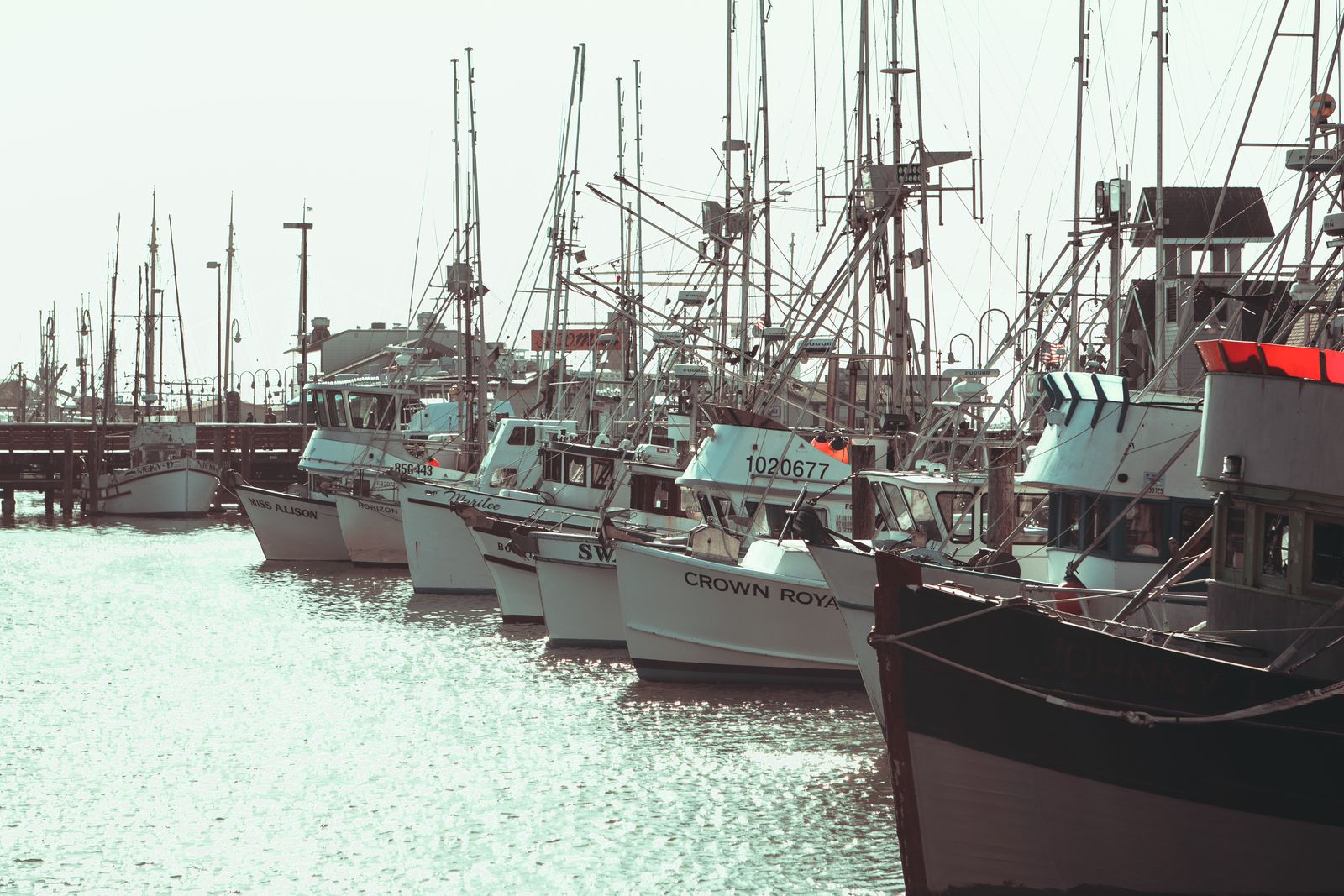
Tim Durheim went out of Ilwaco on 15 August looking for albacore. Forty miles off the Washington coast, aboard the charter boat Four Sea'Sons, something hit a black and pink jig that was not a tuna.
"We were trolling and it came up once hit, disappeared, then came back two minutes later and hit again right at the surface and went down," the Prineville, Oregon angler told the Chinook Observer. "Then we proceeded to battle it for a little over an hour."
The fish nearly spooled the reel of 80-pound braid. It stayed down the whole time.
"I was about 30 minutes in and I still hadn't seen the fish," Durheim said. "Then we saw the stripe. It never surfaced until we brought it to the boat."
At Sportsmen's Canning in Ilwaco, in front of a crowd of fishermen and cannery workers, the digital scale read 151 pounds. The striped marlin measured more than eight and a half feet. The Washington state record it beat - a 134-pounder caught off Westport by Phil Wolff - had stood since September 2005.
Striped marlin belong in water between roughly 68 and 77 degrees. Coastal Washington in August normally runs 53 to 63. There have only ever been a handful of them recorded this far north, and the first, a 104-pounder off Grays Harbor, came in 1997. Both 1997 and 2005 were El Nino years.
"Fishermen are scientists," commercial fisherman Dick Ogg, president of the Bodega Bay Fishermen's Association, told The Press Democrat. "We are always monitoring current, water temperature, color and where we see changes. We look for change and variation as fishermen and we go fish on the edges of this change."
Ogg's crew went several miles offshore for California's commercial salmon opener in May expecting to find the cold water that drives the upwelling salmon feed on. It wasn't there. "A little wind brought in the cold water," he said. "Then we couldn't find the warm water."
His bigger worry is habitat compression - warm water squeezing whales and fish into the same shrinking band of ocean the fleet has to set gear in.
That risk lands squarely on Dungeness crab. At an August 4 hearing of the California Legislature's Joint Committee on Fisheries and Aquaculture, Joanna Grable of the California Department of Fish and Wildlife said the agency is already planning for trouble in the 2026-27 season.
"The department will likely take a conservative approach when opening the fishery this season," Grable said. "Management actions could include a season delay or reductions in the amount of gear depending on the level of (whale) entanglement risk."
On domoic acid, the toxin produced by harmful algal blooms, she was blunter: "This one is going to be a biggie this year."
NOAA Fisheries is less certain the comparison holds. Spokesperson Michael Milstein pointed out that the 2015-16 disaster - when California's crab season was cut from seven months to about two and 71 percent of the state's crab boats stopped fishing - followed the marine heatwave known as The Blob, which had already cooked the Pacific before El Nino arrived.
"This time, we have had some recent heatwaves but there may be less chance of El Nino adding to that," Milstein said in an email. "Rather, it may continue the warming created by the heatwave." He noted that domoic acid has historically tracked marine heatwaves more closely than El Nino itself, and that the fisheries consequences "mainly affect shellfish, including Dungeness crab and recreational fisheries for clams and other shellfish."
The margin for another bad year is thin. California's commercial salmon fleet only returned to the water this season after a three-year shutdown, and Dungeness has been delayed or shortened repeatedly to protect whales.
"It basically took away what summer income these guys have," Ogg told the paper of the closures. "Without that, you're basically waiting until January to get any more money and it's really hard."
State Senator Mike McGuire, who chairs the fisheries committee, put the raw value of California's commercial marine harvest at around $212 million, with total economic impact above $1.2 billion once resale and recreational fishing are counted.
"Climate change continues to reshape our oceans, our rivers and our coastlines," McGuire said at the hearing. "Federal uncertainty has made long-term planning more difficult. All the while, those who depend on healthy fisheries continue to navigate an increasingly unpredictable future."
Climate scientist Daniel Swain, speaking at a town hall McGuire hosted, said the developing pattern could be "an event we haven't seen before in living memory in California."
Nobody can yet say how hard Northern California gets hit. But 151 pounds of subtropical billfish came over the rail off Ilwaco last weekend, which is its own kind of forecast.