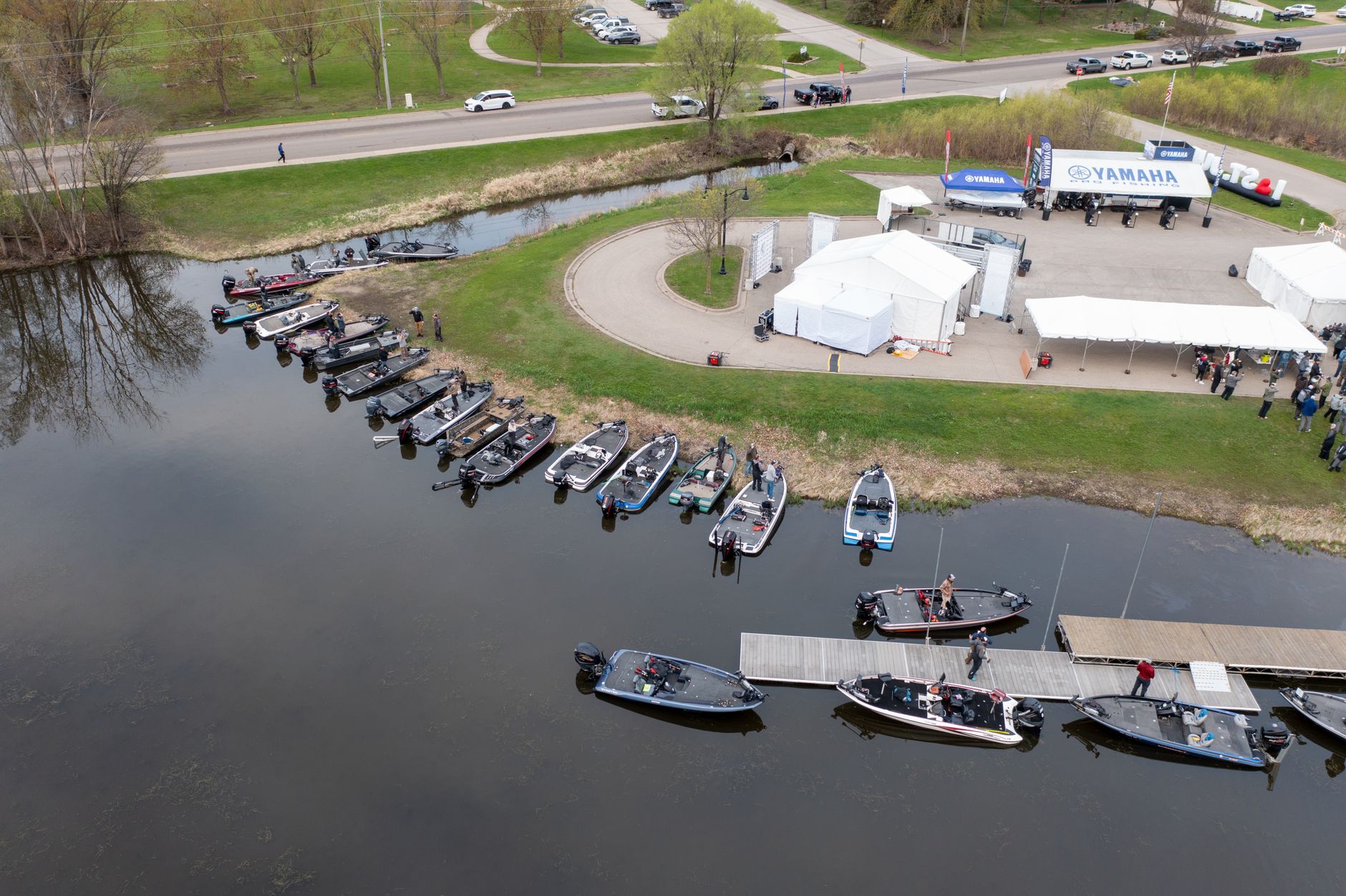
Every fish that won Jesse Spellicy the Toyota Series Northern Division event came off a screen. The lure tied on had been written off by his own neighbours years ago.
Spellicy finished three days at Massena with a 23-pound, 6-ounce closing bag — his heaviest of the week — for 64-13, a $73,689 payday, a first Toyota Series trophy and a guaranteed spot in the Toyota Series Championship in November. Louis Monetti came up 11 ounces short at 64-2, followed by Clay Reece (63-4), Nolan Leger (61-14) and Brayden Stoker (61-13). Carson Stone of Texas won the co-angler side with 50-1, closing with a 19-10 bag.
The venue was a version of the St. Lawrence few of the field had fished competitively. Boundaries kept everyone below Iroquois Dam, shutting out the 1000 Islands and Lake Ontario — the water that gives the river its reputation for 25-pound smallmouth limits. Pre-tournament consensus had 62 pounds winning it.
Spellicy lives in Gouverneur, roughly 40 minutes away, and the boundary happened to lock him inside his best water.
"I knew it was going to be in my wheelhouse, that's the portion of the river that I'm the most familiar with," he said. "It's a little bit of an equalizer with LiveScope. I've always known there are big fish there, but it's very hard to fish traditionally. Incorporating LiveScope, it kind of unlocked that special area."
He fished current breaks in 25 to 35 feet, well below where most of the field was working, and a Day 2 fog delay tilted things further his way. Four hours lost, plus heavy overcast, punished the shallow anglers considerably more than it punished him.
"When I realized that we were actually going to go fishing that day, I thought 'This is my chance to make up some ground'," he said. "I knew that the weights would drop on Day 2 anyways, but I had a feeling that I could catch at least 20 pounds and sustain."
His bait: a brown-back 3.6-inch Berkley MaxScent Flat Worm on a drop-shot with a No. 2 hook and a 3/8- or half-ounce weight. On this stretch of river, that is close to archaeology.
"A lot of my local buddies think I'm joking when I mention a drop-shot," Spellicy said. "They haven't touched a drop-shot in five to seven years up here. But my 10-year-old daughter can catch 16, 17 pounds in a junior cup, dragging a Flat Worm around on obvious-looking stuff."
The name at the top after Day 1 was more surprising still. Byron Hill — an Australian cargo pilot and former Royal Australian Air Force fighter pilot with only a handful of MLF starts behind him — weighed 24-10 of pure smallmouth in a tournament where nobody expected a bag that big to exist.
Hill spent years fishing an Australian bream circuit before a pilot shortage brought him stateside, and he considers the crossover close to direct. "Australian bream is similar to sheepshead, but it's all silver," he said. "They parallel very similar to smallmouth; they do everything the same as a smallmouth bass."
His technique sits at the far end of the technology debate from the eventual winner's: an ultra-finesse jighead, with forward-facing sonar largely beside the point.
"It's just what I know. It's what I've done since I was 10," Hill said. "I'm never going to beat Kevin VanDam jerkbaiting, but I want to think I would have a chance beating him with the jighead — 'Scope or no 'Scope. I've been using the jighead well before 'Scope."
Jimmy Washam, a Tennessee River guide who built his reputation on tailrace smallmouth, led after two days with 44-3 before dropping out of the top five on Sunday. His shortened Day 2 was spent inside the event's three-hour forward-sonar window, then adjusting once the clock ran out.
"It was not quick," Washam said. "The first hour and a half, maybe two hours, I caught three big ones. I caught a 5, a 4 1/2 and a 3 1/2 off that place, lost another big one." The cull that pushed him past 20 pounds came after the sonar period had closed.
Washam has not won since 2021, when he took both a Toyota Series event and the $200,000 Pro Circuit TITLE. He was unusually open about the gap.
"The way that fishing has moved so rapidly and there's so much new talent, I've kind of gone through a mental slump and feeling like maybe I'm not good enough anymore," he said. "And this week has already proven that I am."
A winner who used live sonar to open up water he could not fish conventionally, a Day 1 leader who barely bothers with it, and a former champion racing a sonar clock — for a tournament squeezed onto a fraction of its usual playing field, Massena said a great deal about where the sport is.