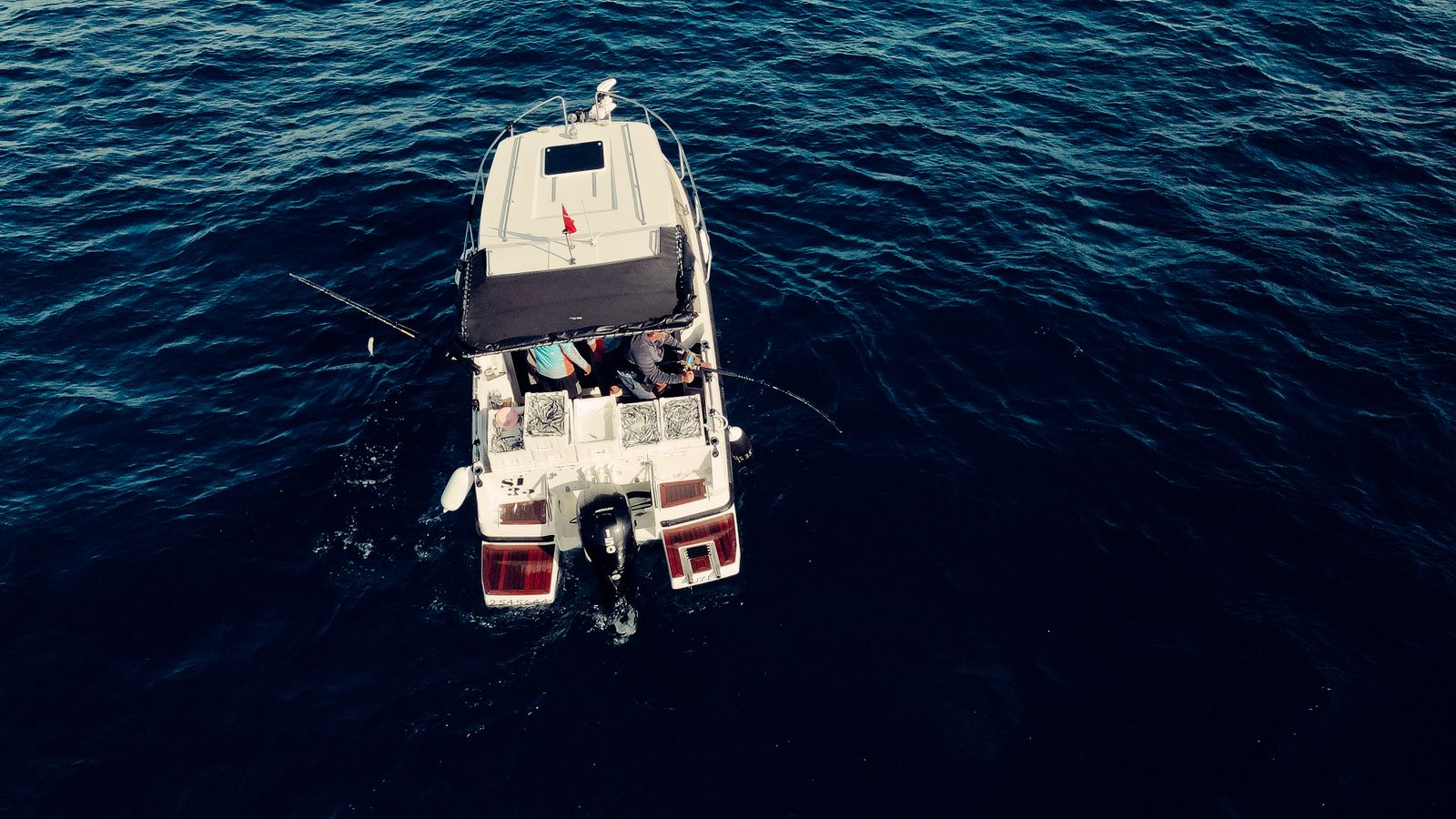
Damon Sacco thought he was looking at a shark. His charter, the Castafari, had spent the morning of August 19 loading up on yellowfin tuna in Atlantis Canyon, roughly 100 miles off Cape Cod, when a fin came up through the surface about four feet high.
"Then I got a better look at it and thought, dang, that thing's pointed," Sacco said. "But that's too big for a marlin."
It was a marlin. Three hours later, after a fight run entirely on rod and reel by his client Walter Chapman, a retired lifelong fisherman from Plymouth, the crew had an Atlantic blue marlin alongside the 45-foot Jim Smith express that would not fit inside the boat. Nearly half of it hung out the tuna door on the run home.
At MacDougall's Cape Cod Marine Service in Falmouth that evening, a certified scale settled on 1,260 pounds. It is the largest blue marlin ever landed on the US East Coast, beating the 1,228-pounder that had stood as the closest challenger out of North Carolina, and it demolishes the previous Massachusetts state record of 873 pounds set in 2015. Against the International Game Fish Association's all-tackle world record - 1,402 pounds, caught off Brazil in 1992 - it fell 142 pounds short.
On The Water, which had a reporter on the dock, watched a crowd build in the dusk as word spread that a possible "grander" was inbound. Sacco himself had guessed 1,040 on the ride in. Estimates in the crowd ran either side of the 1,000-pound mark. Everyone was low.
"My role for most of the adventure was to drive the bus around and yell at people," he said.
The fish put a couple of holes in the transom with its bill on the way in. Sacco calls them war marks.
What makes the catch strange is where it happened. Blue marlin are seasonal visitors to New England at best, and the window is narrow.
"I don't suspect there will be a whole lot of blue marlin caught in the Atlantic in general that are going to top 1,200 pounds for the next several years," said Walt Golet, director of the University of Maine's Pelagic Fisheries Lab and an associate professor in the university's School of Marine Sciences.
The head went to Golet's lab, where researchers will read the otoliths to age it. His working estimate is 25 to 30 years old.
That number is the reason the reaction has not been uniform. Under On The Water's report, commenters objected to a breeding fish of that age and size being killed for a scale reading, calling it wasteful rather than an achievement - a fault line that runs through big-game fishing every time a grander comes over the rail.
"I wasn't going to eat a 1,200 pound fish all by myself," he said. Some of it, he expects, ends up as chowder.
For the people standing on the dock at MacDougall's, the arithmetic was simpler. Katie Curran, of Falmouth, was among them.
"People fish their entire lives and never come close to a catch like this," Curran said. "Hats off to Captain Damon Sacco and the crew on the catch of a lifetime."
The record now sits with a New England charter boat, on a fish that had no business being that far north - and that spent three decades in the ocean getting there.