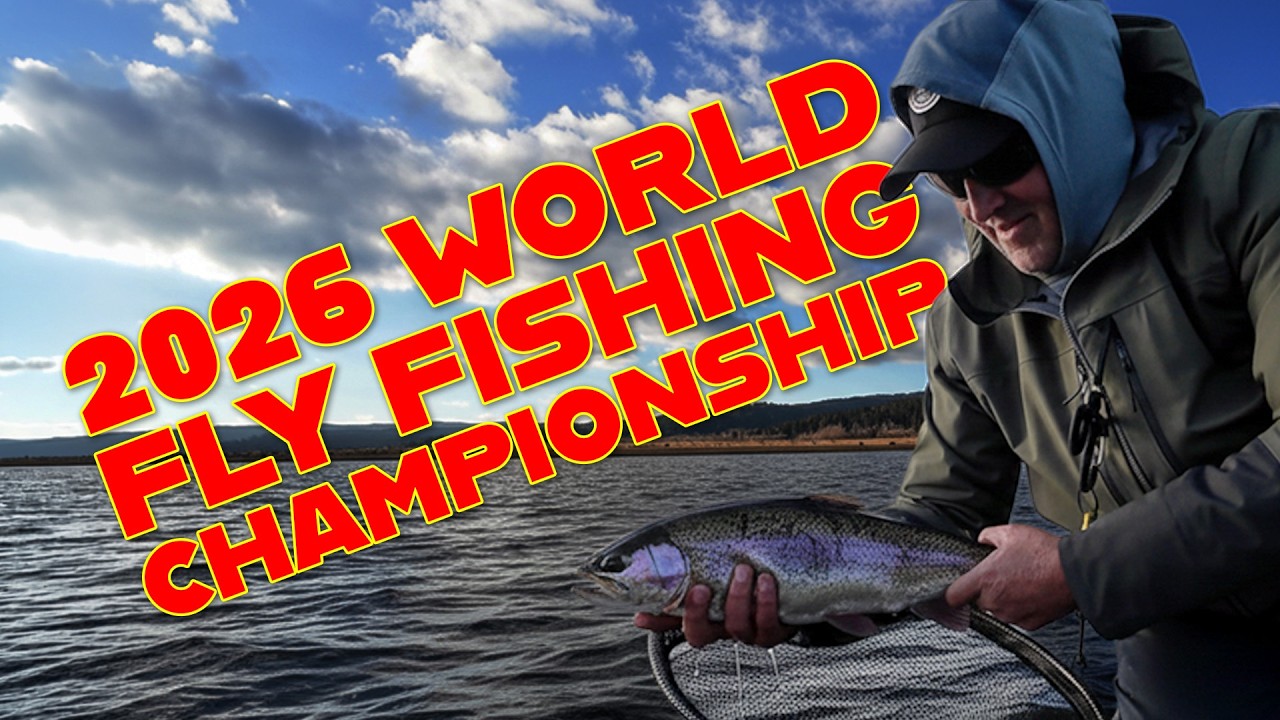
The 45th FIPS-Mouche World Fly Fishing Championship returns to North America in September 2026, and the host city — Idaho Falls — has just been put through its paces by The New Fly Fisher and the event's international organiser, Glade Gunther.
Five venues will carry the load across the five-day competition: the Henry's Fork in two separate beats (Lower Mesa Falls and Coffee Pot Rapids), the Grays River in western Wyoming, and two stillwaters — Hebgen Lake in Montana's Custer Gallatin National Forest and Sheridan Reservoir on Idaho's Eagle Ridge Ranch.
For Gunther, the United States bid was a slow-burn project rooted in the geography around the city. "Idaho Falls is the perfect jumping off city for the World Fly Fishing Championship. It's so close to so many great fly fishing waters," he said. "We have the Snake River that runs right through the middle of town. The two forks of the Snake, the South Fork and the Henry's Fork, are some of the most epic fly fishing waters in the western United States."
Tournament fly fishing has been around for more than 40 years, but the rules and the rhythm remain niche enough to surprise even experienced anglers. Gunther walked through the format on the Grays River, the same beats he and his American teammates fished four weeks earlier at the national championship.
"We literally fished here four weeks ago at our national championship," Gunther said. "The reason why we fished here in the national championship is because we want to make sure that we're spending time practicing getting repetitions on the world championship water."
The river beats are tightly geometric. "Every single angler will be allocated approximately 200 yards, 200 metres of river that they'll be assigned to fish each day," Gunther explained. "This river will be divided up into 25, 26, 27 different stretches of 200 metres each. And that angler is stuck in that spot. So he's got to maximize the number of fish he or she can catch in that stretch over the course of about three hours."
What makes the discipline genuinely different from recreational fly fishing is what competitors are not allowed to do. "We are not allowed to add anything to our rig, our leader, to make it float or to make it sink. In other words, we can't use a strike indicator. We can't add split shot to get it down a little farther," Gunther said. "Everything we do, we have to do with the flies themselves."
The stillwater venues add their own constraints. Power boats are prohibited, anchors are off limits, and electronics including fish-finders and GPS are banned. Competitors instead drift with drogues — small underwater chutes used to slow and steer the boat — and must memorise structure during pre-fishing.
The cutthroat-heavy Grays River produced about a dozen fish on the day of the preview despite a major weather drop, and the Henry's Fork's Lower Mesa Falls section delivered Henry's Fork rainbows and a wild brown trout on a chironomid-and-emerger rig. "There is no lack of fish in this run, I'll tell you," The New Fly Fisher's host said after pinning a heavy fish out of a deep slot.
Coffee Pot Rapids on the upper Henry's Fork, above Island Park Reservoir, is the smallest and most pockety of the five venues — and likely the toughest beat of the schedule. "I got a sense that this would be one of the more challenging beats during the tournament," the host noted.
The bid that brought the championship to Idaho was a joint submission from the United States England Confederation and USA Fly Fishing two years ago. Gunther says the city was the right choice for reasons that go beyond the trout. "We rely heavily upon the hotels, the restaurants, other activities that Idaho Falls has to offer. There's places for us to do opening and closing ceremonies, and most importantly, there's a great population of willing people to help volunteer for the World Fly Fishing Championship."
The volunteer ask is sizeable. "Mostly a volunteer is there to help make sure that the anglers follow the rules, but more importantly, you get a chance to watch them fish and you get to measure every fish that they catch. For every angler, we need a volunteer," Gunther said. "We're expecting to require approximately 100 volunteers every day for 5 days in the middle of September."
The contact-nymphing techniques on display — long fine leaders down to 7X tippet, no indicator, rod held high to feel takes — were the through-line of every river session. As Gunther put it on the Henry's Fork, the question is not what flies to use, but how fast you can get them where the fish are. "We're looking for the broadest diversity, highest skilled angler. River skills, lake skills."