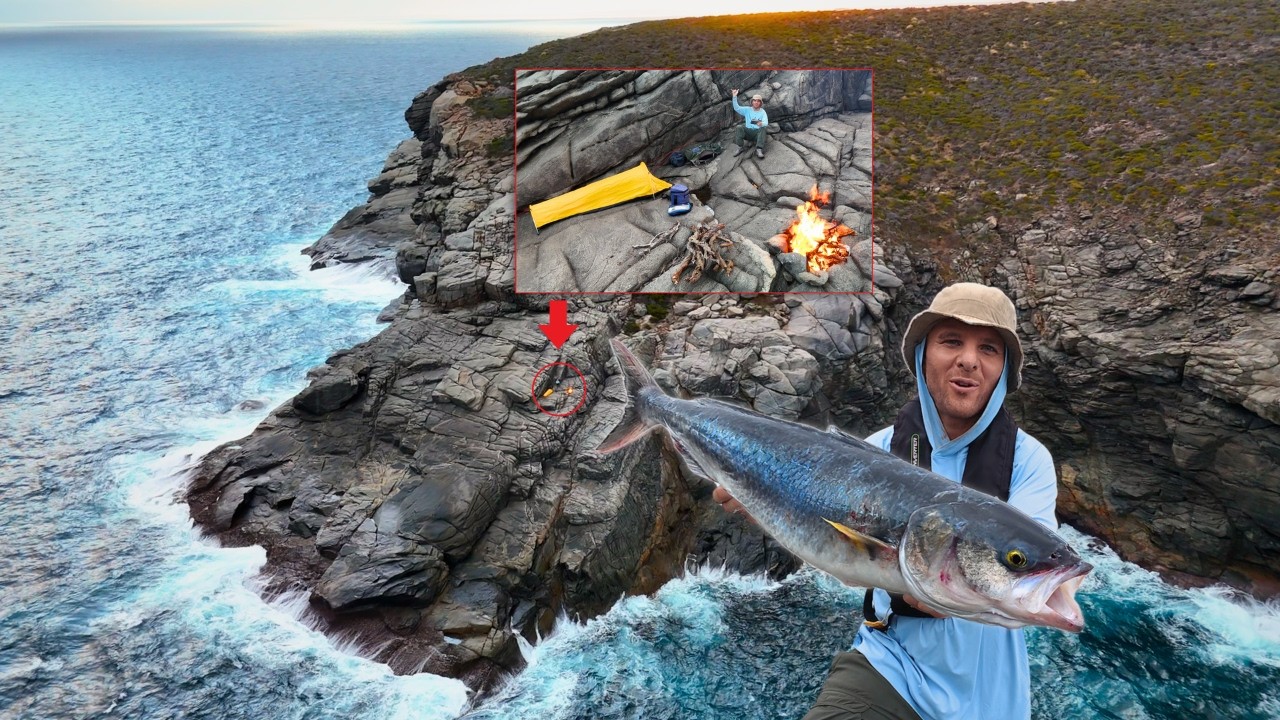
The wild south coast of Western Australia keeps producing the kind of solo rock fishing missions most anglers will only ever watch on a screen - and Surviving Fishing Adventures has just dropped another one. The brief was simple: hike out to a remote ledge on the edge of huge cliffs, find a flat big enough to pitch a tent, fish for dinner, and cook it on the fire.
"We hiked out to a very remote ledge to set up camp, catch our dinner, woo, and have fun while challenging ourselves," he told the camera in the opening minutes. "This spot took a big effort to reach - heavy pack, long hike, and some sketchy terrain right along the edge of huge cliffs. But that's what makes these trips special: the challenge, the isolation."
The first job, before fishing, was logistics. The ledge he marked as a fishing platform was sheer; the camp site sat back from it on a barely-flat shelf. "This looks nice and flat. Not the biggest spot, but it might have to do us," he said, dumping the pack and rolling straight into the casting platform with a burley pot, a heavy metal rod and a cliff gaff staged on the rock in case anything serious turned up.
The Southern Ocean delivered fast. Heavy metals cast into the wash drew salmon almost immediately - the first true sign that the autumn run is moving along the coast. "Where there's one, there might be more," he said as the first schoolie kicked on the deck. "Yep, there is a few salmon down there."
The first fish he kept for dinner, with the rest filed away as live bait if nothing better turned up. "It might become dinner, but we're still trying to upgrade it. Definitely good bait as well," he said before sending a tail-flicking salmon back into the white water.
The upgrade came on the lighter rod. After a quiet stretch of casting metals into clean blue water, a swap to a smaller lure and different colour produced a heavier take. "I felt that. Fish on. It's not just a herring. I'm not sure what it is," he said as the fish came up the wash with a swollen swim bladder hanging from its mouth - a textbook deep-water surface. "Breaksea cod? I think it is. Oh, and a good one. Nice. That's a good size breaksea cod."
On the mat it taped out at 38 cm - "a good eater" - gutted, iced and packed away in the cooler bag before he switched rigs again. The next round was bait fishing on the pulley rig with the heavy outfit. "That is a pulley rig," he explained as he clipped the bait in and lobbed it out into the wash.
The pulley delivered. After feeling out the kelp, extending the line down to the sinker to stay above the bottom growth, he hooked and landed a second breaksea cod of similar size. "Here we go. Another beautiful breaksea cod. This one is coming on. Now we're going to pack up the fishing gear, set up the tent, collect firewood, get a fire cranking. I'm hungry."
What followed was the part most anglers do not see. Fishing gear stowed on the ledge, tent up on the flat, firewood collected from the scrub above the cliff, and dinner - fresh breaksea cod fillets - cooked on the rocks with the Southern Ocean rolling in below. The plan to leave the gear on the ledge for first light was just as ambitious. "Tomorrow morning, right back into it," he said before settling in.
For anglers eyeing the WA south-coast rock platforms this autumn, the takeaway is the same one Surviving Fishing Adventures has been hammering for months: a heavy throw bait for the salmon run, a lighter spin outfit for the breaksea cod, a pulley rig for kelp country, and the willingness to carry it all in on foot.