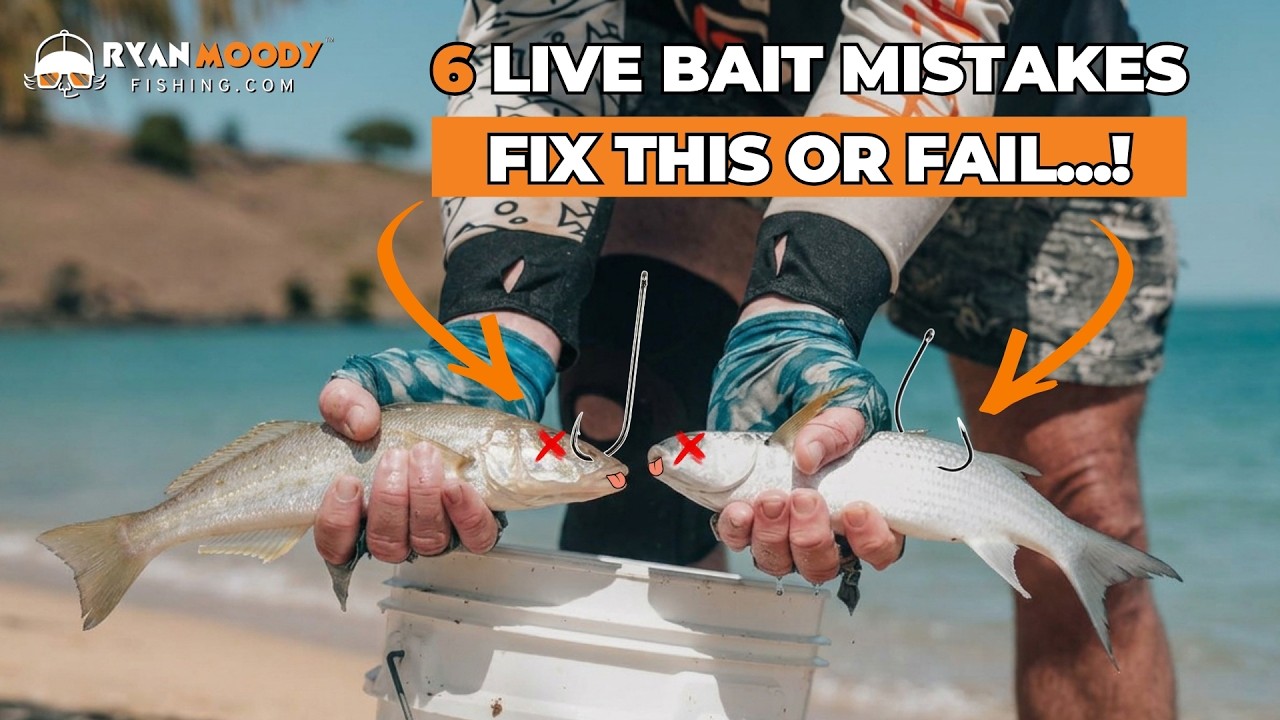
Australian fishing educator Ryan Moody has used a new tutorial to walk anglers through six recurring mistakes he sees on the water with live bait, arguing that small errors in hook choice, rigging and bait care are routinely costing people shots at trophy fish.
Moody, a long-time charter operator and online coach whose Ryan Moody Fishing channel has built a following of around 150,000 subscribers, framed the video around four decades of observation. "Live baiting is one of the most effective ways to catch many trophy fish," he said. "And after four decades on the water, I see people make a lot of mistakes. I'm going to touch on six of those right now."
The first is the simplest: matching hook size to bait size. Moody showed a 10/0 circle hook used for large live baits and said he often sees anglers trying to force that hardware onto small liveys. "I have seen people try to pin small liveys like this through the tail, and it just doesn't work, simply because the hole that it makes is too big. And when you cast it, the bait generally flies off." For a small mullet, he recommended stepping down to a 5/0 or 6/0 at the largest.

The second mistake was pinning live baits through the middle of the back. "That is not aerodynamic whatsoever," Moody said. "If you hook baits in the middle of the back, they just sit there and they spin in the current. It's not aerodynamic, they die quickly, and they don't look appealing to the fish." He noted that herring can be hooked through the nose or eye sockets, while smaller mullet are better pinned through the tail — not on top of the backbone.
Moody's third point tackled a common crossover error: using a large-bait nose-hook technique on small baitfish. "These smaller baits don't have that kind of affordability to be able to put a hook in there," he said, explaining that small mullet have too little meat between the nose tip and the eye socket to hold a hook reliably.
The fourth mistake was bait care before the cast is even made. Anglers catching mullet and other baitfish often leave them on hot sand while they sort gear, which strips scales and stresses the fish. "They need to be put straight into fresh, oxygenated salt water immediately," Moody said.
A fifth, related error is overstocking bait tanks. "If you overfill them, the fish bump into each other, and they're forced into the sides, losing scales. And not only does losing scales kill fish, but too many fish in a small area there's less oxygen in the water for them, as well. So, a lot of your liveys are going to die sooner than later."
Finally, Moody warned anglers off the wrong hardware — specifically long-shank hooks meant for chunk or strip baits. Live bait, he said, triggers a different predatory response. "Because it really brings out the predatory instincts in fish, they generally smash it whole. Whereas chunk baits and that, they generally come up and pick away at it before they take a good bite." The long shank, he explained, sits in the fish's mouth awkwardly when a whole-bait strike comes, leading to poor hook-ups.
The video closes with Moody pointing anglers to his online course "Locating Liveys" for deeper work on where to find bait through the tide cycle. Across the six points, the common thread is care at every step — from the beach to the cast — rather than any single piece of kit.