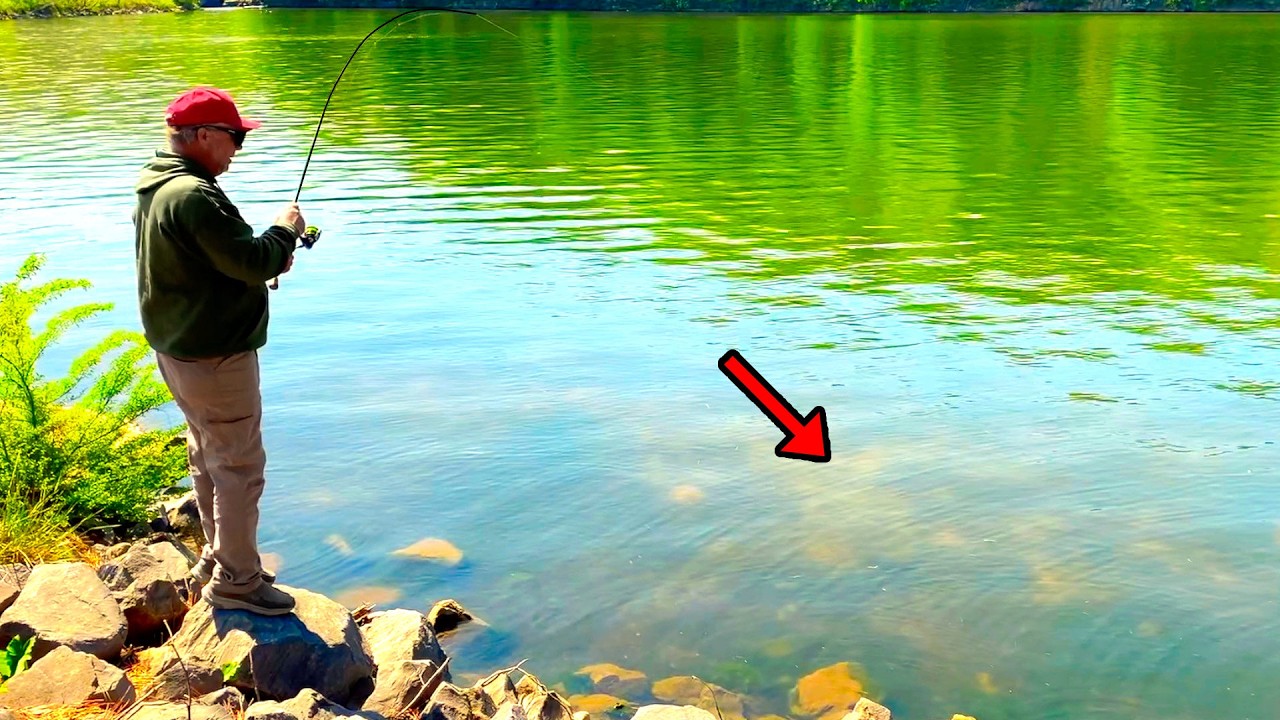
Veteran crappie angler Richard Gene, host of the Richard Gene 'The Fishing Machine' YouTube channel, has delivered a concise breakdown of why he considers rip wrap — the big, road-building rocks used to prevent bank erosion — one of the best springtime spawning targets on the Tennessee River system.
Gene opens by explaining that not all rip wrap is equal. "Sand and pea gravel are the two most favorite places here in the Tennessee River for crappie to spawn," he said, pointing out the base of a stretch of rock where the bottom substrate transitions from rock to sand. "They have to have one or the other. They're not going to spawn on a real soft bottom." Rip-wrap banks that sit on marshy, mucky bottoms, he added, almost never hold spawners.
Depth is the second filter. Gene filmed the video with a surface water temperature already up to 67°F and candidly told viewers the window is closing: "The spawn is not going to last much longer. When it hits that 70-degree mark, it's about over with for the most part." Crappie, he noted, spawn only once a year, beginning to develop eggs in autumn but not laying until water temperatures climb into the 60-to-70°F band.
In clear water — the conditions he was fishing — Gene targets crappie holding at roughly 4 ft of depth, five to 12 ft out from the actual bank, and tight against the rocks. "These crappie will come right by the bank, imagine this, in between big rocks like this, and they'll dish out dishes about that size right there, and that's what they're spawning on," he said. In dingy or stained water, the spawners push shallower.
Tackle-wise, Gene is running a 6'9" compre-X ultralight rod and a Shimano Miravel 1000 loaded with three-pound P-Line paddle-fish monofilament, which he described as a recent favourite: "I've been fishing with this P-Line for a while now… It's strong and they stretch, but not a whole lot of stretch, and it don't have all this kinking problem that a lot of monofilament lines have." His lure is a Max 4 soft plastic made with Elastamax — the same material Nico uses — paired with a 1/32 oz jig head. "You'll lose them before you'll wear them out," he said of the bait's durability.
The 1/32 oz head is central to the method. "A 1/32 ounce jig head's got to be my favorite, favorite size," Gene told viewers. "You can hold it in front of their face for a much longer period of time." The Max 4's elastic-like material, he said, makes the slow-fall even more exaggerated, often producing bites on the drop even when the retrieve is practically motionless.
Early in the session the rig produced exactly the sort of fish the method is designed to find — a thick female pushing 15 inches that Gene estimated at well over two pounds. "That's a hammer right there," he said. "Now, this is a female and she's still got some eggs in her. So we're going to release her back real quick." Reassuring viewers worried about disturbing spawners, he cited fisheries research that says the fish will return to the same bed if released quickly. A second cast on the same stretch produced a 12.5-inch male, confirming the pattern.
For anglers planning late-spawn trips, the takeaway is a short checklist: rip wrap over sand and pea gravel, 1/32 oz jig head, a durable soft plastic fished slow, and a willingness to cast within two to four feet of the bank.