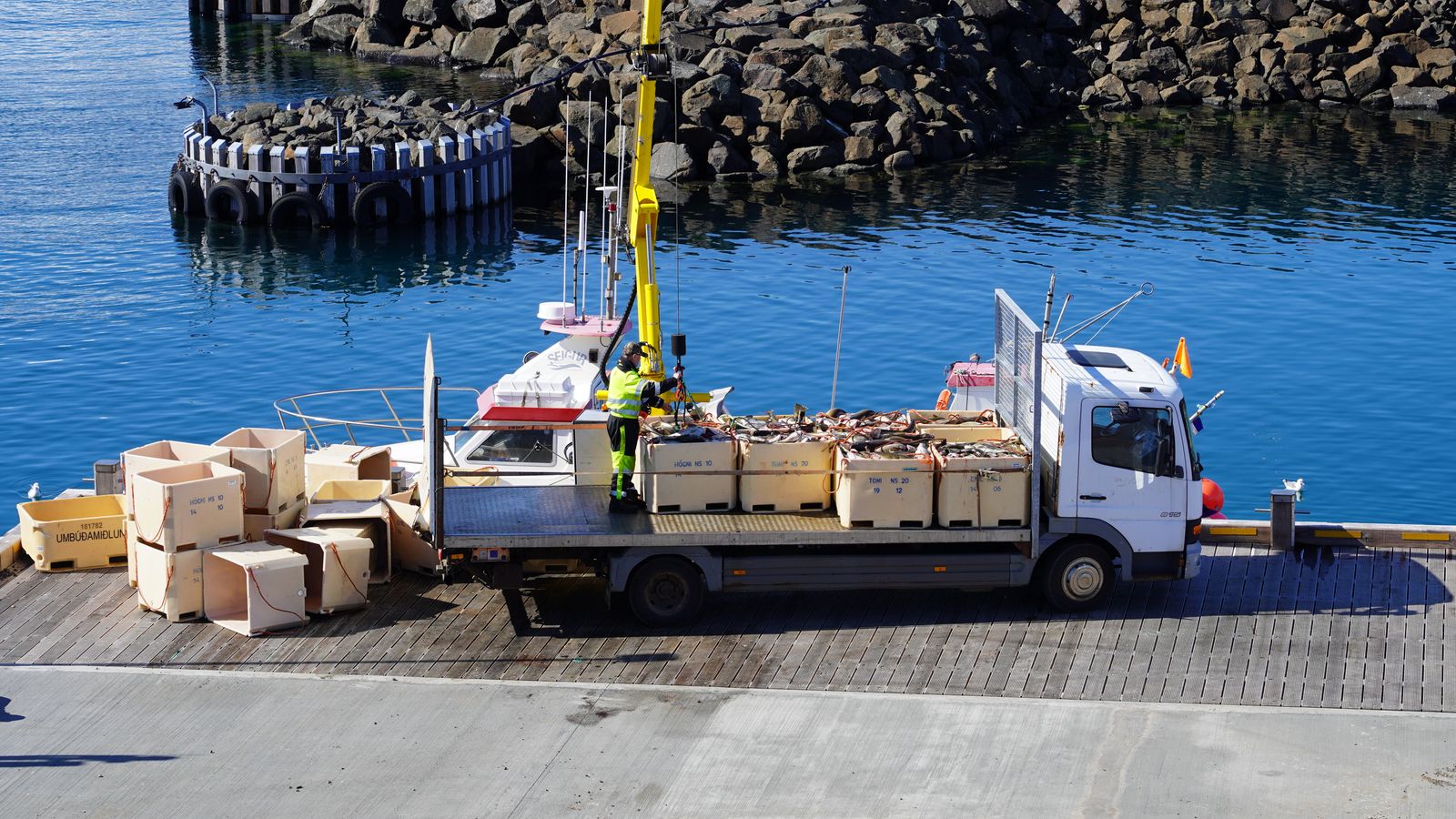
When Icelanders go to the polls on August 29, the ballot paper asks about the European Union. The argument, almost everywhere on the island, has been about fish.
Voters are being asked only whether accession negotiations — suspended in 2013 and formally ended two years later — should resume. Membership itself would require a second referendum on whatever treaty emerged. Yet fisheries sank the previous round of talks, and neither side pretends this campaign is about anything else.
Ahead of the vote, the government stated its red line. Foreign Minister Thorgerdur Katrin Gunnarsdottir told the Financial Times that control of Iceland's fisheries and its quota system would not be given up in negotiations, and that any settlement would have to accommodate the way Iceland runs one of Europe's biggest fishing industries. Prime Minister Kristrun Frostadottir has cast the referendum as a way to finally resolve what she described as "a debate that has hung over the Icelandic nation."
Fishing companies want firmer guarantees. Heidrun Lind Marteinsdottir, managing director of the Association of Companies in the Fisheries Industry (SFS), set out the industry's case in Vidskiptabladid on July 22, arguing that the sector's performance is a product of the management system rather than the size of its firms.
"The success of the Icelandic fisheries sector is not based on the size of the companies but on the fisheries management system," she said. "The premise of this success is that Iceland has had full control over the fishing grounds and the basic principles of fisheries management."
By global standards the fleet's owners are modest operations. Four Icelandic firms appear in Undercurrent News' list of the 150 largest seafood, fisheries and aquaculture companies: Iceland Seafood International and Samherji share 102nd, Brim sits at 120th and Sildarvinnslan at 147th. Even the whole country's seafood and aquaculture exports — more than ISK 400 billion in 2024 — would place only ninth on that list if they belonged to one company.
"The Icelandic fishing industry is small in an international context. That is simply a fact, although Iceland is sometimes referred to as a 'fishing superpower'," Marteinsdottir said.
Adopting the bloc's Common Fisheries Policy, she argued, would not be a paperwork exercise. "Adaptation to the EU's Common Fisheries Policy would not be a technical formality but a fundamental change in a nation's basic industry," she said. "Then Iceland would no longer have the last word on the rules that shape the exploitation, management and future of its fisheries resources."
Ownership is the second worry. Free movement of capital would, on SFS's reading, let foreign companies acquire vessels, fishing businesses or fishing rights outright — the quota-hopping pattern seen elsewhere in the bloc.
Fisheries Iceland put a similar argument into a 23-page paper opposing membership, noting the industry generates roughly 40 percent of national exports. "The success in the fishing industry was not a given but the result of Icelandic decisions on the basis that Iceland has full control of its fishing resources and its exclusive fishing zone," the document said.
The counter-argument is that nobody knows the terms until they sit down. Gunnar Thor Petursson, a law professor at Reykjavik University, told RUV that the claim there is nothing to negotiate is simply untrue, citing member states that have won permanent derogations. Consultancy Arctica Finance concluded in late April that Iceland's biggest fishing companies would come out ahead under membership even with no quota exemptions at all, because quota values would climb.
Brussels has left room to move. Costas Kadis, the European Commissioner for Fisheries and Oceans, told the Financial Times that exemptions covering fisheries and aquaculture were possible. "We can find solutions on issues that are a challenge, such as sharing arrangements on shared fish stocks," he said. "Iceland and the European Union are coming closer - taking into consideration recent geopolitical developments."
The Faroe Islands are paying attention. Bardur a Steig Nielsen, the territory's minister of foreign relations and fisheries, said an Icelandic agreement that kept national control intact would alter Torshavn's thinking: "The road would be paved for us joining the EU." Seafood makes up around 95 percent of Faroese exports.
Opponents want the decision made without outside commentary. Gudrun Hafsteinsdottir, who chairs the centre-right Independence Party and its 14 seats in the 63-member Althing, told POLITICO that European politicians should keep their distance.
"It's extremely important that this decision in August will be left to the Icelandic nation," she said. "People should just let Icelanders go through this without foreign influences." Her objection to membership is jurisdictional: "The question is whether Iceland should transfer key decisions over fisheries, agriculture and economic policy to the EU. And I believe that is not in Iceland's interest."
The mood has shifted her way. An April poll found 47 percent opposed to membership against 40 percent in favour — the reverse of a year earlier, when 44 percent supported it and 36 percent did not. On the narrower question of restarting talks, the country is close to evenly split.
"We are divided into nearly equal groups for yes and no," Hafsteinsdottir said. "The referendum will be very tight."