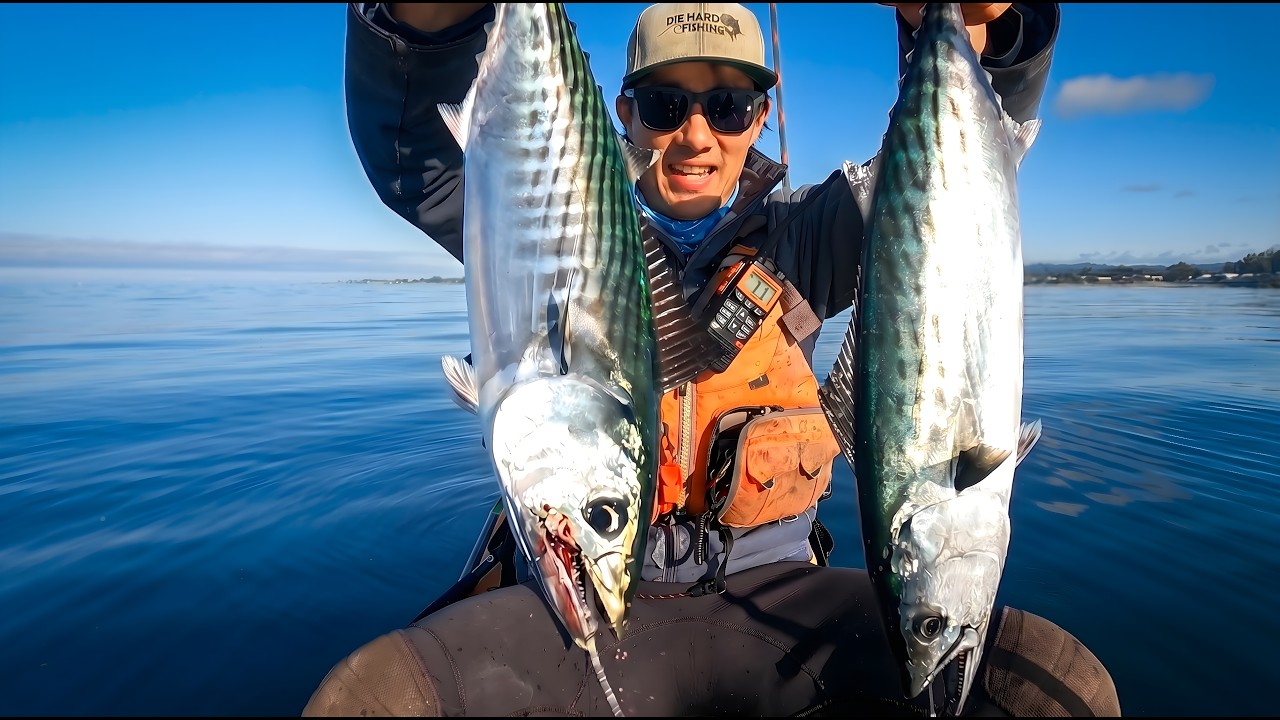
Northern California kayak anglers chasing halibut over the spring flats are starting to log a species the region rarely sees this time of year — Pacific bonito — and at least one Bay Area kayaker has blamed warming sea-surface temperatures and an El Nino-style pattern for the switch.
The angler behind the Die Hard Fishing channel paddled out before dawn this week with a familiar dodger-and-hoochie setup, targeting halibut over the local sand flats. Instead, he spent the morning trolling through boiling schools of bait — and after the first double hook-up the morning's plan had quietly changed.
"Up. Oh, double, double. We're on. Oh my god. Double. Pretty sure these are blue," he called as both rods doubled over. "I'm pretty sure these are bonito. We got him. It worked."
The kayaker put the fish, and the missing halibut, in the same climate frame. "These are definitely more common down in Southern California, but we do get them up here in Northern California," he said. "People have been kind of rumouring around. I've heard some rumours that it might be an El Nino year, which means that we'll get some warmer water up here. And if we get warmer water, it's definitely more likely to see more pelagic species like this one."
His fish finder read 57.5F over the flats — warm by Bay Area standards for the season — which he believes both pulled the bonito north and pushed his halibut search sideways. "I'm thinking maybe everything is just kind of messed up because of this El Nino thing," he said. "You know, the water is definitely warmer right now than it normally is this time of year. So maybe it's just throwing the whole thing off. I mean, right here where I'm fishing, my fish finder, I don't know if it's right or not, but it says 57 1/2 degrees which is pretty warm. Probably why the bonito are here. But there should be halibet as well."
There is a second theory worth flagging for Northern Californian flatfish anglers — that the bonito are simply intercepting the same forage halibut would otherwise key on. "Maybe the bonito are eating everything before the halibet can get to it," the angler suggested. "So I don't know what's going on with the halibet, but I couldn't find any today."
Once he had three Pacific bonito on ice he turned the conversation toward eating quality, which divides Californian anglers. "Now, these are very underrated fish in my humble opinion," he said. "A lot of people, especially in Southern California, kind of frown on these probably because they have the bigger tuna. It's hard to blame them. But I personally really think these cut up real well."
His handling rules were specific. "The biggest thing with these, you got to take care of them," he said. "I want to make sure I bleed them and put them on ice as quickly as possible, so that the meat stays good. I think that's the main reason why they get such a bad rap — is people just don't take the time to take care of them properly."
The session also surfaced a fishery quirk Bay Area kayakers rarely get to talk about — the chance to fight pelagics on a sit-on-top, rather than offshore boats. "It's not often that you can go out on your kayak in the Bay Area and go fish for pelagic fish," he said.
After three bonito on the dodger-and-hoochie rig, he went back to dragging for halibut and reported nothing on the spike except a few small black rockfish across roughly five hours of trolling — a quiet day by historical Bay Area spring norms.
The takeaway for anglers booking similar trips in the next few weeks: pack a heavier leader, keep an ice box ready, and watch the surface for explosive bait activity. If recent sea-surface temperature readings hold, more pelagic visitors are likely to keep showing up where halibut would normally be holding.