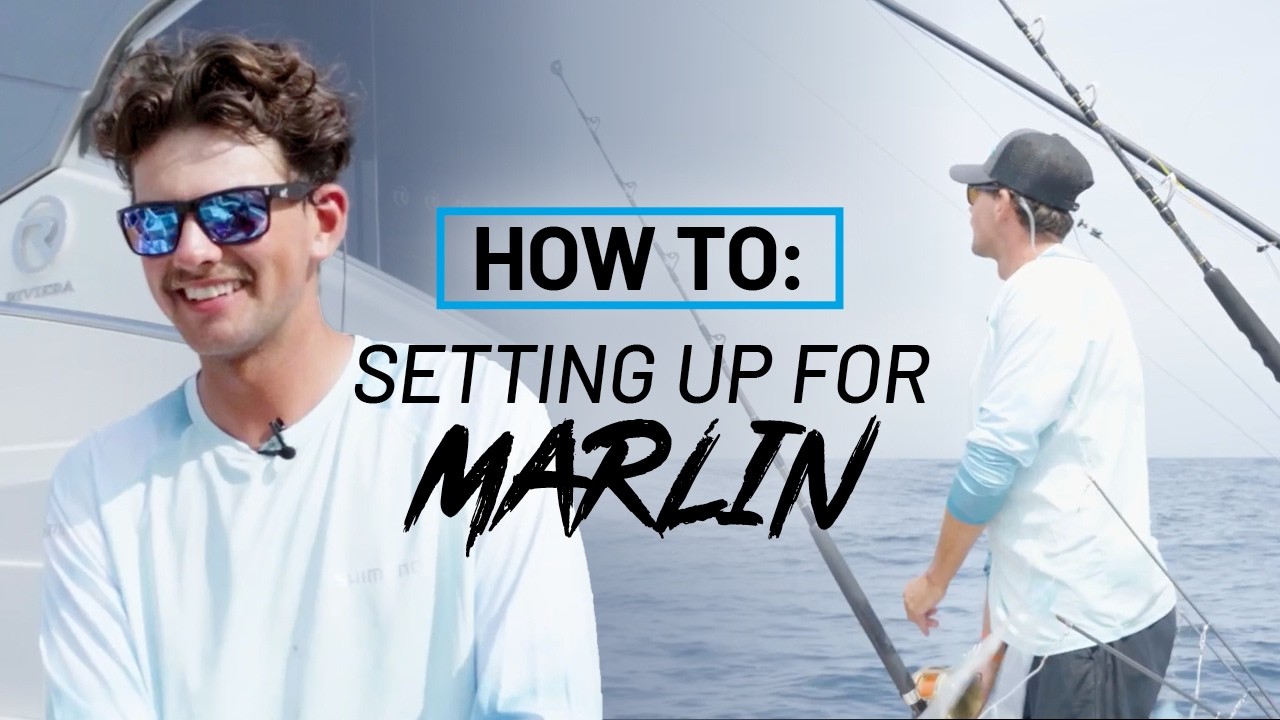
Marlin fishing on the east coast of Australia can be daunting on the first attempt — but Shimano Pro Team angler and Haven Sport Fishing Charters crewman Dylan Moebus reckons the live-bait setup is simpler than most newcomers expect.
In a how-to dropped to the Shimano Australia channel in early April, the Port Stephens-based crewman walked viewers through a complete inshore-and-offshore live-baiting rig and the small habits that separate productive marlin trips from blank ones.
"It can be quite daunting at first, but it can be quite simple," Moebus said. "We're mainly going to cover live baiting today."
His outfit recommendation splits the east-coast marlin fishery into two zones. For inshore work he runs a 15-kilogram Speedmaster game rod paired with a Speedmaster 16 two-speed lever drag, on 15 kg main line. "Ten kg is quite light, and 15 kg, you can easily knock over most fish here," he said. For offshore work he steps up to a 24 kg Speedmaster game rod and a Tiagra 30 wide loaded with 24 kg line. "Going 15 kg on the shelf, you can get done over by some larger fish. So that 24 kg up in the line class there just allows you to combat those larger fishes a bit more."
Two-speed lever drags are non-negotiable. "For this game fishing for marlin and tuna, all that sort of stuff, definitely need a lever drag, and that two-speed does come in handy quite often — being able to bump down to that single speed there on those larger fish."
Leader work is fluorocarbon only. He runs 60 to 80 lb on the inshore outfit and 100 to 150 lb offshore. "Fluorocarbon is pretty much invisible in the water, high abrasion resistance. And to be competitive in this live bait fishing, you definitely need to use that fluorocarbon."
Hooks are circles, snelled to the leader rather than crimped. "It's well known circle hooks have your best chance having the best hook-up rate, and also for best fish survivability." The snell follows the curvature of the leader and improves hook orientation, and Moebus says it cracks off cleanly at the boat — "a lot easier, a lot safer. You don't have a hook coming flying back at you."
His preferred bait is a slimy mackerel, hand-line caught with a bit of bait flesh on the jig over a special burley mix. The cardinal sin is mishandling. "We don't want to touch them or anything. No dropping them. No chucking them around. Straight in the bait tank." Slimies that get bumped, he warned, lose their slime and start spinning behind the boat by mid-afternoon.
The bait is bridled — half-hitched onto a circle hook with 20 lb fluorocarbon and threaded through the front of the head with a small needle — then deployed on a release clip that holds the line with a 10-wrap twist. "You want when you get the bite, that marlin's going to come eat that bait. He's not going to feel anything but slack line."
His standard spread is two baits and one teaser: a 'short corner' at 15 to 20 m and a 'long corner' at 30 to 40 m, with a dredge teaser working close behind the boat. He leaves multi-teaser setups to the heavy charter boats. "No need three different teasers. Just keep it nice and simple. One dredge, two baits."
The remaining 80 per cent of the job is watching. Skipping or spinning slimies often signal a marlin chasing the bait — or a tired livey that needs swapping. Moebus's blunt closer for new game fishers: "Marlin fishing — 98 per cent boredom, 2 per cent excitement."