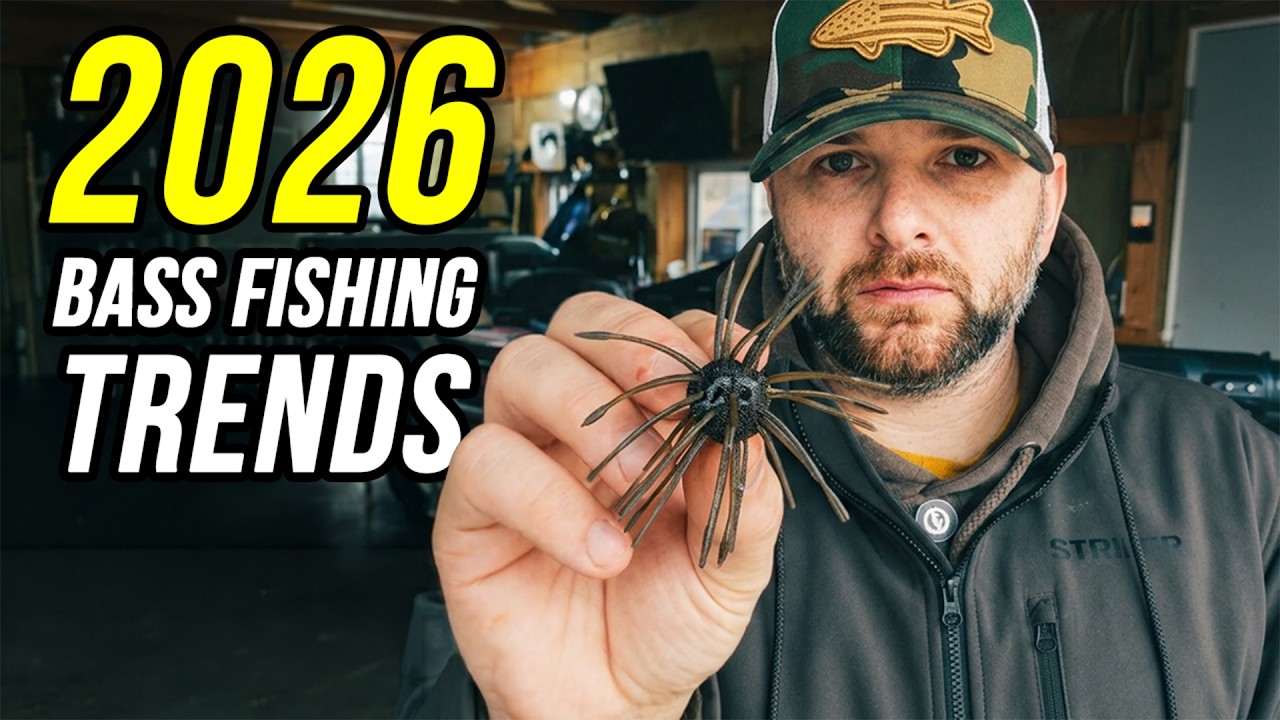
Tournament angler Benjamin Nowak has published a 2026 trend forecast arguing that the pace of change in bass fishing has accelerated sharply — and that the anglers who stay ahead of trend cycles measured in months, not years, will hold a hard-to-price edge on the water this season.
"One thing that I've been thinking about a lot lately is the speed that trends are evolving in the sport of bass fishing," Nowak said in his breakdown. "It's not like in the past when the ChatterBait came out in 2000 and then took till 2008, 2009 before that bait started catching on. Or the Whopper Plopper came out in 2013 and then by 2016, 2017, really hit mainstream. It seems like baits that are trending become trends and that trend goes away a lot more quickly."
The headline trend is urchin-style baits. Nowak called out the Hayabusa Koi Ki as the current market leader, with the Yamamoto Uni — featuring bulbs at the tips of its tentacles — a strong second. Built from stretchy, durable TPE elastomer, the urchins create a micro-vibration on the fall rather than the glide or flutter signature of traditional soft plastics.
"The fuzzy dice or these urchin trends, these baits with tentacles coming off of them, are the top trend, and it's not just for forward-facing sonar," Nowak said. "This is a bait where when those fish are feeding up, you can get them to commit to these urchin-style presentations." He expects urchins to shine in colder water where slower presentations win, acting as a Senko-adjacent option for negative fish.
The second distinct bait category to watch is the fuzzy dice — compact cubes skirted with silicone or living rubber strands. The Strike King Tumbleweed and OSP Dice are among the first-wave options, with X Zone and others already following. "What makes the dice different than your urchin-style baits is that these dice to me are going to be in warmer water situations," Nowak said. His primary use case is drop-shotting and sight-fishing pressured smallmouth, where the dice can be fished more erratically above a target than the slower urchin profile allows.
Trend three is what Nowak called the battle of the extremes — a hardening split between micro baits of 2.25 inches or smaller and big-profile presentations at seven inches and up. The micro end includes the Great Lakes Finesse Drop Minnow at 2.25 inches, two-inch tubes, and 1.7-inch Snack Craws. On the other end, seven-inch Z-Man Jerk Shads and big-profile minnows are shifting out of the pure big-bait swimbait niche into general use on pressured fisheries.
"This world of extremes, going extremely big, going extremely small, is going to help you stand out from the rest of the baits out there and help you trick more fish," Nowak said. He pointed to bass keying on six- to eight-inch perch and alewife as the reason larger minnow-profile baits work for three- to five-pound smallmouth, and argued micro baits function as a bite-extender on fish turned off by standard presentations.
Trend four is technique-specific terminal tackle. Nowak flagged the Gamakatsu Horizon Head — a flat-topped jig head designed to hold a minnow horizontally on forward-facing-sonar presentations — as the archetype. He also highlighted the Jika rig, a setup that hangs the weight underneath a hook-ring for more pivot and action.
"Adopting technique-specific terminal tackle that is unique or allows you to present your bait in the perfect presentation is going to become more and more critical as these fish get more and more pressured," he said.
The fifth is about application rather than hardware. Nowak argued that taking traditional presentations into unexpected water columns — weighting crankbaits to run deeper, choosing ultra-shallow jerkbaits to work inches of water — will continue to separate anglers on pressured lakes. "Taking these techniques that we're really used to and comfortable with and fishing them differently, thinking outside of the box to give ourselves advantages on the water, especially as these fish are being more and more pressured, is something that I continue to see," he said.