A 23-foot centre console out of Orange Beach, a 7-inch jerk squid loaded onto a horizontal-eye jig head, and a 105-foot reef stacked solid with red snapper added up to a non-stop bite for Bama Saltwater's Stephen on a recent Easter-weekend solo trip — even though every fish on board had to go straight back over the rail.
In a video posted to the Bama Saltwater channel about a month ago, Stephen used the closed snapper season as an excuse to test a new jerk-squid jig presentation off the Alabama coast and ended up with a clinic in slow-pitch jigging through the middle of the water column.
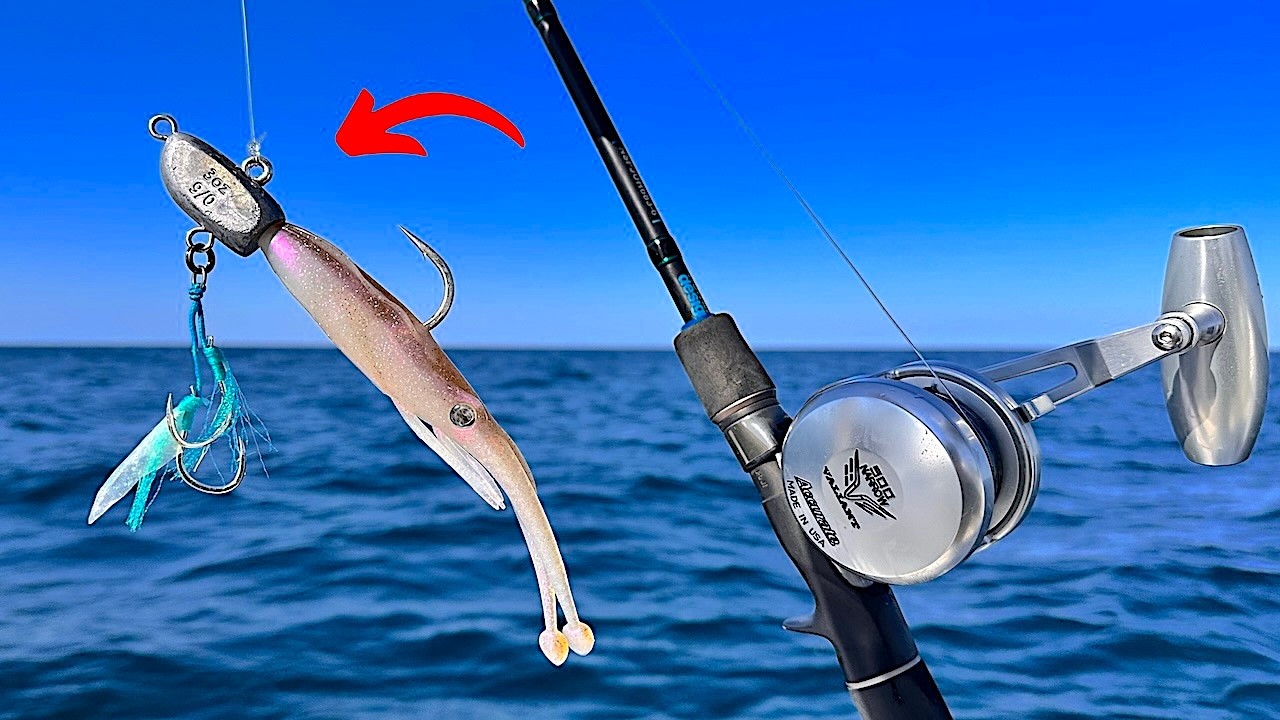
"My setup's pretty easy," Stephen said on the rail. "It's 50-pound fluorocarbon leader. I do a PR knot to 30-pound braid. Accurate Valiant 500 narrow. This is my dedicated slow-pitch setup. There's not much this thing can't catch."
The bait was a 7-inch jerk squid threaded onto a horizontal jig head with two assist hooks attached via a heavy-duty split ring. The line tied to the top eye of the jig head, which keeps the squid sitting horizontally — the natural orientation for a squid in the water column. "If I was casting, I tie it to the front," he noted. "The hook-up ratio is so much better."
His drop was the unusual part. He never let the lure hit the bottom. Instead he stopped it short of the 105-foot reef and worked it through the middle of the water column with slow, deliberate lifts and pauses. "Drop it down a few seconds. Let it sit there. Lift it. Let it fall. And they hit it on that drop," he said as the rod loaded once more.
Every fish came up red. The fishery he was sitting over was clearly stacked with snapper, even with the season closed. "I think we're sitting on top of a lot of red snapper, though, which is no surprise. They're very abundant. The strict regulations — there's a reason they are abundant because of those strict regulations." He carefully released each fish, noting that because they weren't coming straight off the bottom they showed no signs of barotrauma and could swim back down on their own.
The squid bait itself proved durable through the bite — TPE material, stretchy, body intact through fish after fish. The plastic eyes tend to come off as the bait gets chewed, but the profile holds.
Most snappers committed on the fall, which Stephen flagged as the hallmark response for the slow-pitch jerk-squid presentation: "That one hit it on the fall, which is what majority of them are going to do with a lure like this."
After several drops on the same reef without finding anything other than reds, Stephen pulled up and ran for a weed line that was just starting to form closer to shore. A small jerk squid on a half-ounce jig head got hit on a topwater cast — a feisty bonita that he kept for bait. The bonita then burped up a small cluster of natural squid the same size as his lure. "Can't say I'm throwing the wrong bait," he said.
A drifting sea turtle ghosted the boat at one point with no cobia in tow, and a brief grass-line search turned up little more than the usual Easter-weekend wind. The trip wrapped after an unsuccessful run for mahi mahi and a brief crab-pot pull on the way home.
The takeaway for Gulf anglers: a jerk squid on a horizontal jig head fished mid-column — never letting it hit the bottom — is a solid out-of-snapper-season strategy when reefs in 100-plus feet of water are stacked with closed-season fish. It puts a hook in front of the bigger trigger and bee-liner candidates without dragging on bottom, and it bites best on the fall.